
Why Knowledge Graphs Work. Here's the Research.
Machine-readable knowledge measurably improves how AI systems retrieve, ground and cite your facts. Not as a claim, as a result. Here is the mechanism, the specific risks it removes, the peer-reviewed evidence, and what the same effect looks like in our own production data.
Start with why the gap exists at all
A model's knowledge is not live. It is formed mainly during pretraining and reflects the world up to a cutoff, then freezes. Ask an assistant a buying question about this quarter and, on parametric memory alone, it answers from a snapshot that can be a year or more stale. Current facts only enter an answer when the system can retrieve them at request time, through live search, a connected database, or a grounding step. Google's own grounding documentation describes exactly this: the model is connected to current, verifiable sources so its output can be checked against them rather than invented.
Which surfaces a blunt question most companies have never answered. If you have never cleanly defined, documented and published what your own entities are, in a form a machine can read, how is an AI system supposed to get them right? The model has no privileged access to your internal knowledge. It has only what it can find and parse in the moment.
A knowledge graph, a clean machine-readable representation of what your company is, makes and claims, exists to answer that question on your behalf. And the reason it works is clearest in the specific failures it removes.
The five failures a knowledge graph removes
Hallucination. When your facts are unclear, contradictory or scattered, a model fills the gap with something plausible and wrong. A dense page of clear, provable, dated facts shrinks the space in which the model has to guess. You do not argue a model out of a hallucination, you remove the vacuum that produced it.
Entity confusion. Weaker entities get absorbed by dominant meanings: a namesake, a bigger competitor, the generic category. Give an entity its own clearly defined semantic contour and it stops drowning in the noise of stronger terms. The model can finally tell you apart from the thing you are constantly confused with.
Non-mention. Anything created after the training cutoff, a new product, a new role, a rebrand, may not exist in parametric memory at all, so it never appears in an answer. A retrievable, structured page activates a new entity in days, without waiting for the next model to be trained.
Misattribution. When five sources say five different things about you, the model averages the noise. One authoritative source of citable, structured facts collapses that spread into a single consistent signal.
Language bias. Retrieval skews English-heavy, which quietly demotes non-English markets. Facts published cleanly in the market's own language get retrieved in that language, instead of being reconstructed through a translation of someone else's summary.
Notice what none of these are: ranking tricks. They are disambiguation. The job of a machine-readable layer is not to game a score, it is to make the true version of your facts the cheapest and clearest one available at the moment an answer is assembled.
Why the machine-readable version wins the fetch
A modern assistant does not store and replay your facts. It reconstructs an answer at request time from three inputs: what the model already knows, what it retrieves live, and the probabilistic context in between. The retrieved input is the one you can influence this quarter, and retrieval is selective.
Two findings make the mechanism concrete. First, retrieval systems extract information primarily from visible, readable page content, not from metadata or markup buried in the head of a JavaScript-rendered page. The facts have to be present, in the body, cheap to parse. Second, grounding is decided by content fit at the moment of the query, semantic similarity in vector space, not by years of accumulated click and link authority. That is why a clean reference page can start appearing in answers within days, long before it would earn a classic search ranking.
Both describe a surface a conversion-optimized marketing site was never built to be. A marketing page persuades. A reference page clarifies. They are not competitors, they do different jobs, and most companies only own the first one.
The measured lift
This is where the case stops being architectural and becomes numeric.
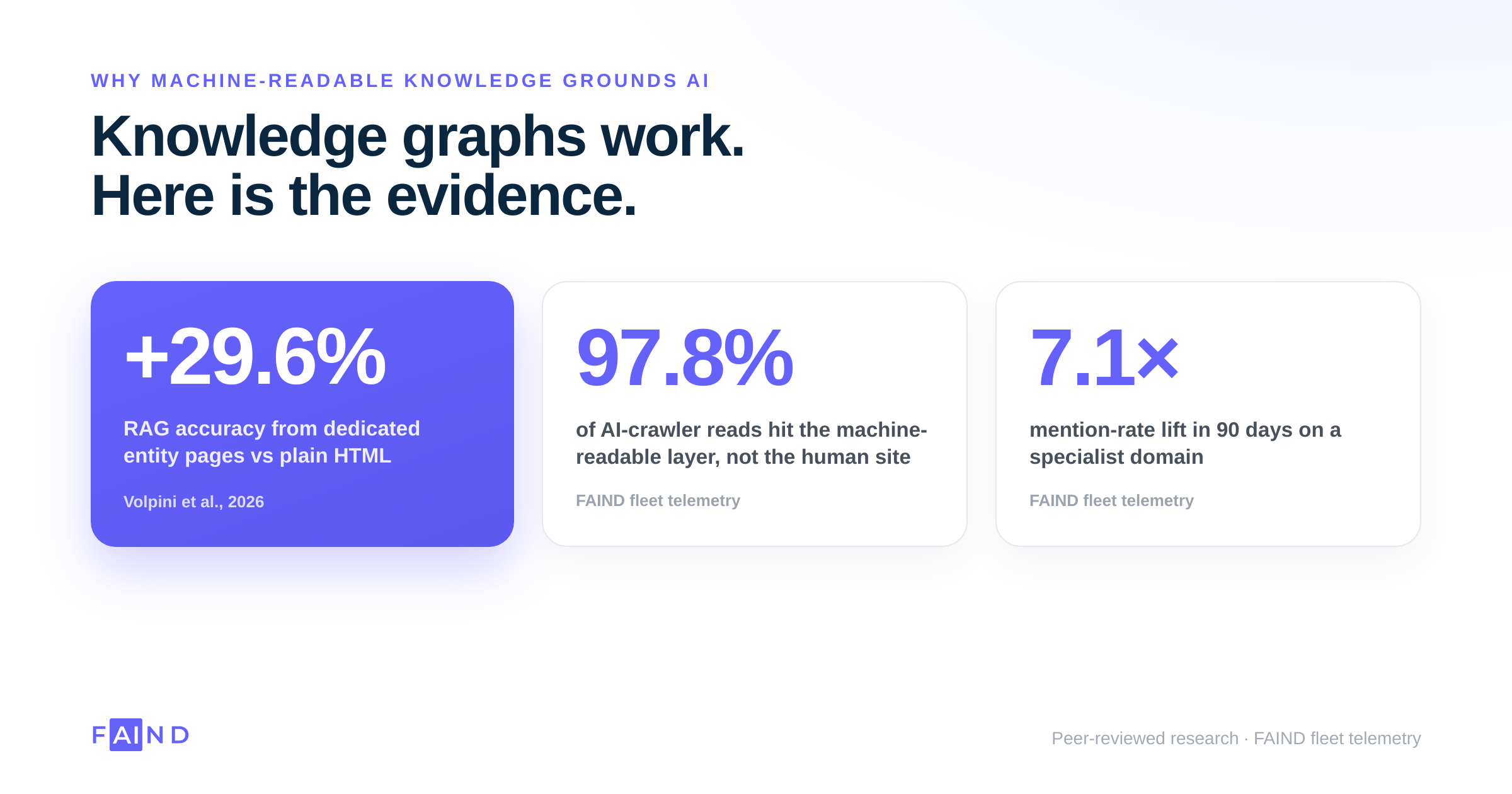
In a controlled study across four domains, editorial, legal, travel and e-commerce, researchers rebuilt content into dedicated entity pages, one page per entity, with facts directly visible and navigable. Against plain HTML, the restructuring produced a 29.6% accuracy improvement for standard retrieval-augmented generation and 29.8% for a full agentic pipeline, with the strongest configuration reaching 4.85 out of 5.0 for accuracy (Volpini et al., 2026). That is not a rounding-error effect. It is the distance between an answer a buyer can act on and one they cannot.
It lines up with how AI search chooses sources in the first place. Separate University of Toronto work on Generative Engine Optimization found AI answer engines lean systematically toward authoritative, well-structured sources when they decide what to surface and cite (Chen et al., 2025). Structure and clarity get retrieved and trusted. Noise gets skipped.
What a knowledge graph is, and is not
Worth being precise, because the idea gets oversold. A knowledge graph layer is entity-focused reference material: high information density, clean structure that is easy to chunk, verifiable dated facts, no promotional filler. It is not a replacement for SEO, it complements it, one drives traffic to your site, the other governs how you are represented inside answers. It is not a magic ranking factor and it does not replace earned authority like press and reviews. And it is not enormous. For most companies the entities that genuinely need this treatment, the organization, the key people, the core products and methods, come to a manageable set, often somewhere between five and twenty pages. Not every URL. The facts that decide answers.
What our own fleet sees
We can confirm all of this from the other end of the pipe, in production, on real customer domains.
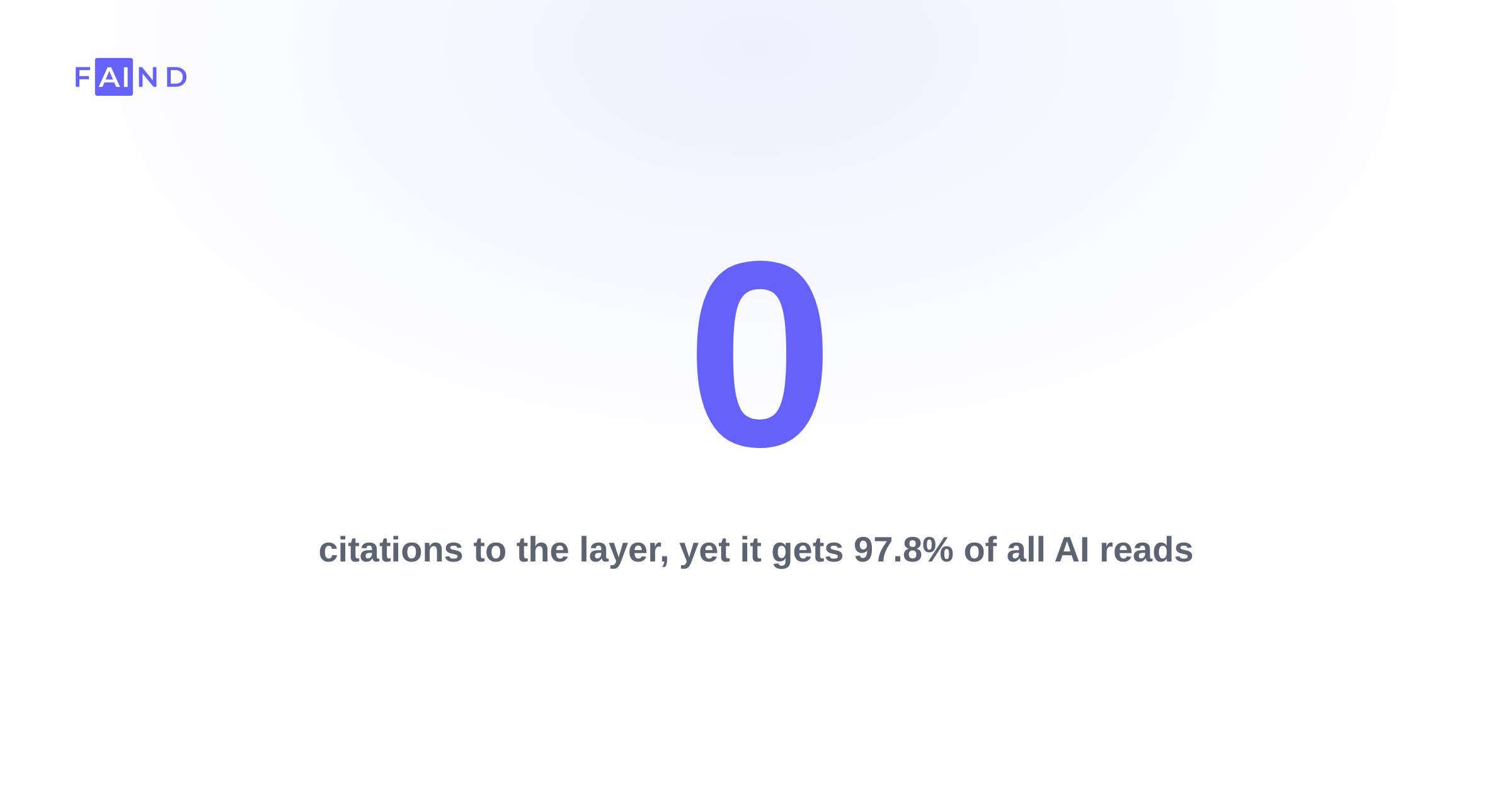
When a customer runs a machine-readable Knowledge Graph layer beside their human site, the crawlers vote with their fetches. On one monitored domain, 97.8% of 16,502 AI-crawler requests over five months went to the machine-optimized layer rather than the human website, because it is the cheapest, clearest, most extractable representation available. And every checked citation still resolved to the customer's own domain, not to the layer, so all of the credit lands at home.
The effect shows up where it counts, in the answers. In a 90-day window, one specialist we work with moved from being named in 3.9% of monitored AI answers to 27.5%, a 7.1 times lift, with active recommendations rising from 14.3% to 41.8%, while its own website's Google clicks grew in parallel rather than being traded away. The mechanism the research describes is the mechanism we watch move a number every month.
The practical question is not whether a machine-readable knowledge layer helps. It is whether yours exists yet, and whether an assistant answering a buyer about you today is grounding on your facts or reconstructing them from a two-year-old memory.
See what AI actually retrieves about your brand: our free AI Visibility Audit runs your category's real buying questions across ChatGPT, Claude and Google AI Overviews, and shows you what the machines can read today.
Sources: Volpini et al., "Structured Linked Data as a Memory Layer for Agent-Orchestrated Retrieval," arXiv:2603.10700 (2026); Chen et al., "Generative Engine Optimization: How to Dominate AI Search," University of Toronto, arXiv:2509.08919 (2025); Google Cloud grounding documentation, Vertex AI (2026); FAIND fleet telemetry, BFE Institut (observed Feb-Jun 2026) and econ solutions (observed Jan-Apr 2026).
More in Original Research
Zero Citations, Total Influence: What Fleet Data Says About How AI Actually Uses a Knowledge Graph
We run cited-host analysis across every Knowledge Graph we operate. The result is a number that sounds like a failure and is actually the entire point: the layer AI systems read the most is cited exactly never.
Mention, Citation, Recommendation: Three Metrics That Are Not Interchangeable
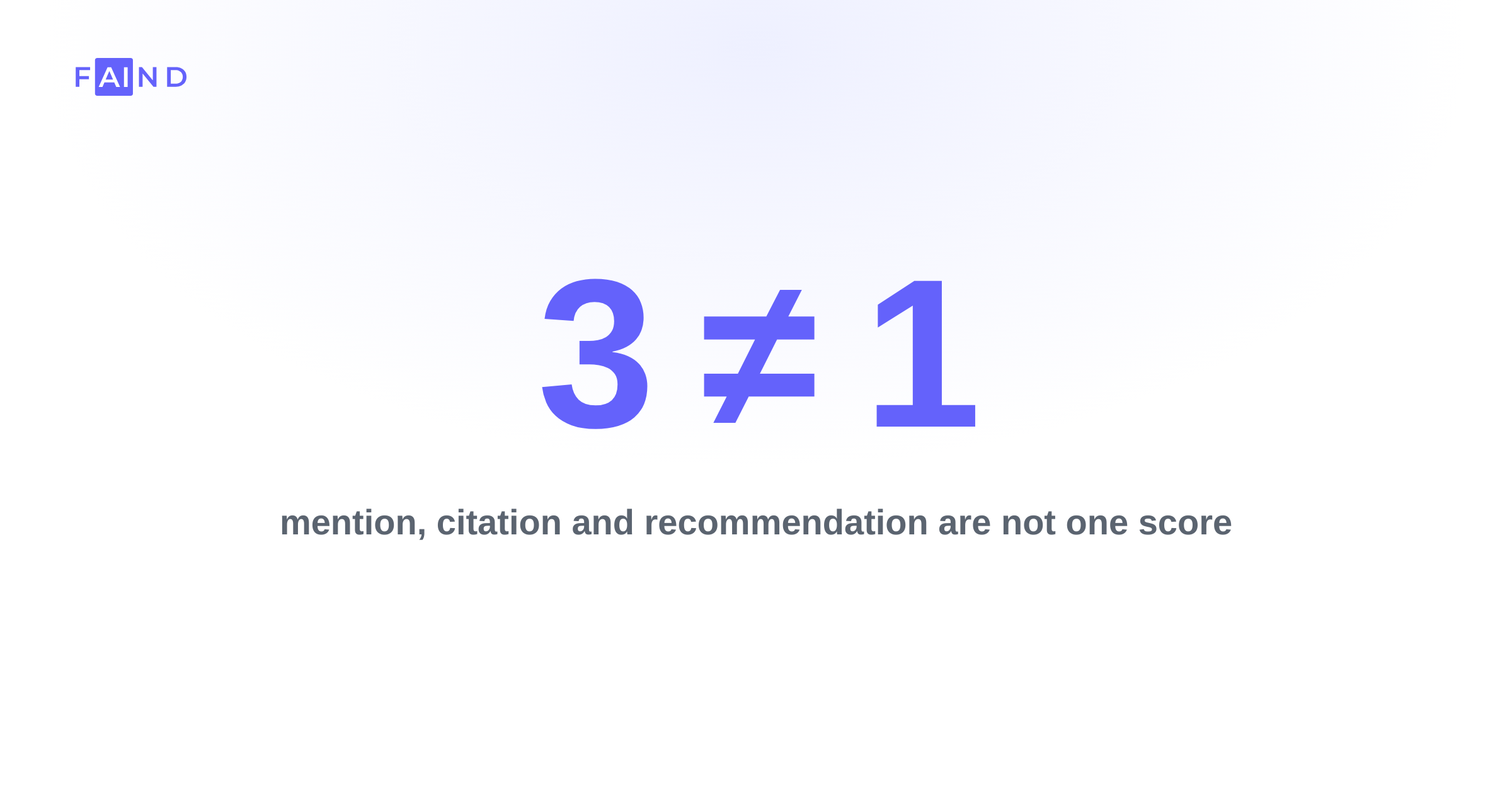
The fastest way to spot an immature AI-visibility program is a single number: "our AI visibility score is 61." Visibility in AI answers isn't one thing. It's three distinct events, being named, being used as a source, being actively suggested, that move independently, mean different things commercially, and diagnose different problems when they diverge. This is the taxonomy we score every answer against, and what the gaps between the three levels tell you.