
Mention, Citation, Recommendation: Three Metrics That Are Not Interchangeable
The fastest way to spot an immature AI-visibility program is a single number: "our AI visibility score is 61." Visibility in AI answers isn't one thing. It's three distinct events, being named, being used as a source, being actively suggested, that move independently, mean different things commercially, and diagnose different problems when they diverge. This is the taxonomy we score every answer against, and what the gaps between the three levels tell you.
The three levels, defined
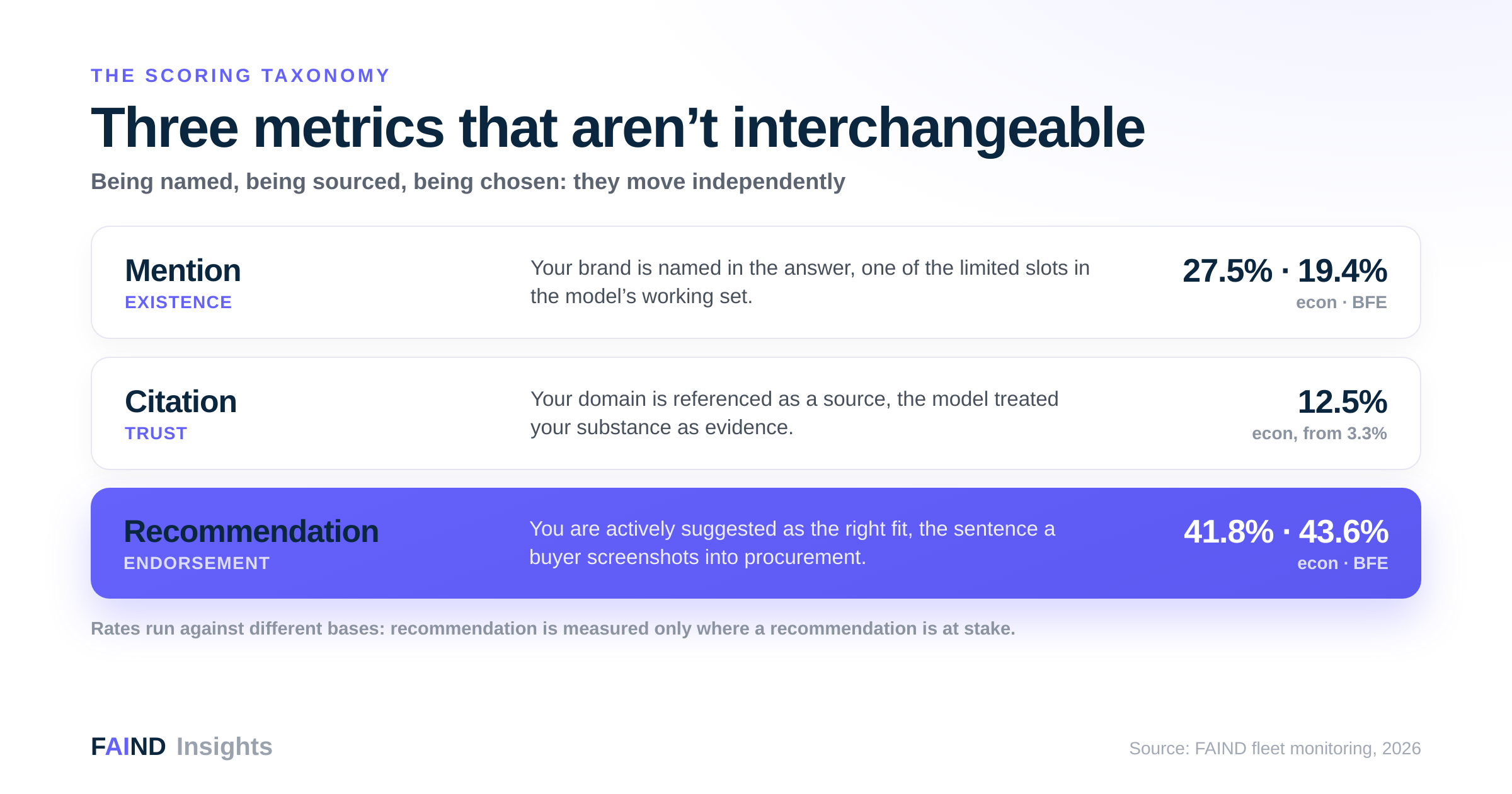
Every AI answer in our monitoring panels gets classified by how it treats the brand, a ladder from passive presence to active endorsement:
Citation, the brand referenced as a source. The answer points at your domain: a link, a source list entry, a "according to [your site]." Citation is the trust event: the model treated your published substance as evidence worth attributing. A citation can occur without much said about you at all, your page grounded a claim, and the pointer proves it.
Mention, the brand named in the answer. Your company appears in the text: listed among options, described, referenced in passing. Mention is the existence event: at the moment this answer was assembled, your entity occupied one of the limited slots in the model's working set. No mention means that, for this buyer and this question, you did not exist.
Recommendation, the brand actively suggested as the right fit. Not "econ solutions is one option among others" but "for your requirements, econ solutions is the strongest choice." Recommendation is the endorsement event, the model committed to you, and it's the level closest to pipeline, because it's the sentence a buyer screenshots into the procurement thread.
Sentiment is scored separately, on top. A mention can be neutral, positive, or negative; a brand can even be "recommended against." So every answer additionally carries a tone classification, and negative-tone responses are tracked as their own category, because a single systematically negative pattern is a five-alarm finding regardless of how the volume metrics look. Across both published cases, for the record: zero negative responses observed.
Why the numbers can't be blended, or naively compared
Here's where a subtle but critical point hides, best shown with real numbers. In our econ solutions case: mention rate 27.5%, citation rate 12.5%, recommendation rate 41.8%. In the BFE case: mention rate 19.4%, recommendation rate 43.6%.
A careful reader stops here: how can a brand be recommended more often than it's mentioned? It can't, within the same set of answers. The resolution is that the metrics deliberately run against different bases. Mention and citation rates are measured across the full monitored panel, all six intent types, including long-tail informational questions where no brand recommendation is even possible ("How do I size a dosing pump?" has no shortlist). Recommendation rate is measured where a recommendation is at stake, the high-intent, decision-style questions where the model is actually choosing. Blending those bases into one score would average a decision metric with an awareness metric and tell you nothing about either.
This is also why share of voice, the fourth number in our standard report, requires one more piece of discipline: a defined competitive set. "12.0% share of voice, #2 of 10" (BFE's June standing) is a meaningful sentence only because the ten tracked competitors are named in advance and held constant. Share of voice against an undefined field is a number that can be made to say anything.
Reading the gaps: four diagnostic patterns
The individual metrics report status. The relationships between them diagnose. Four patterns cover most of what we see:
High mention, low citation: known but not sourced. The model names you, your entity exists in its world, but never treats your domain as evidence. Usually a substance-accessibility problem: your claims exist, but not in a form retrieval systems can fetch and attribute (JavaScript-rendered pages, facts buried in prose, no machine-readable layer). The model knows of you from third parties; it can't ground anything in you. econ's starting position had this shape.
High citation, low mention: sourced but not summoned. Rarer, and interesting: your pages ground answers, but your brand doesn't get named in them. Typically an entity-resolution problem, your content is useful, your identity is muddy (name collisions, inconsistent naming across the web, weak entity signals). The substance works; the brand isn't attached to it firmly enough to surface.
High mention, low recommendation: shortlisted but never chosen. You appear in the lists, and the model consistently picks someone else. This is a differentiation problem, not a visibility problem: the extractable case for why you over the alternatives is weak or absent. More content won't fix it; sharper, machine-legible positioning against the fan-out's vs questions will. It's also the pattern that most reliably predicts what human buyers will do, since they're reading the same comparisons.
Strong recommendations, thin mentions: decision-strong, authority-thin. You win when the buying question is explicit, but you're absent from the discovery and informational long tail around it. Sturdy for capturing existing demand, fragile for shaping it, buyers who start two questions earlier in the journey never encounter you. The fix lives in topical coverage of the informational fan-out.
The 90-day trajectories in our cases are these patterns in motion: econ moved all three levels together, 7.1× mention, 3.8× citation, 2.9× recommendation, which is what a substance-and-accessibility fix looks like when it lands. BFE's most dramatic move was recommendation (0% → 43.6%): the model didn't just learn BFE exists, it learned enough verified, extractable substance to commit to it.
What this means for how you buy (or build) monitoring
Four requirements fall out of the taxonomy, and they double as a vendor checklist. Insist on level-classified scoring, any tool reporting one blended "visibility score" is compressing away the diagnosis. Insist on stated denominators, you should be able to say what every percentage is a percentage of. Insist on a named competitive set for share of voice. And insist on separate sentiment tracking, because the difference between "mentioned" and "mentioned as the cautionary example" is not a nuance.
Our monthly report carries exactly these four, mention rate, citation rate, recommendation rate, share of voice, each per provider, sentiment on top, because this taxonomy is what we'd want to be judged by. The free AI Visibility Audit scores your brand against all of it, and the prompt-library guide shows how to reproduce the measurement yourself.
Sources: FAIND scoring methodology (as published in the econ solutions and BFE Institut case studies, 2026); FAIND fleet monitoring, 180 responses per run across ChatGPT, Claude and Google AI Overviews.
More in Original Research
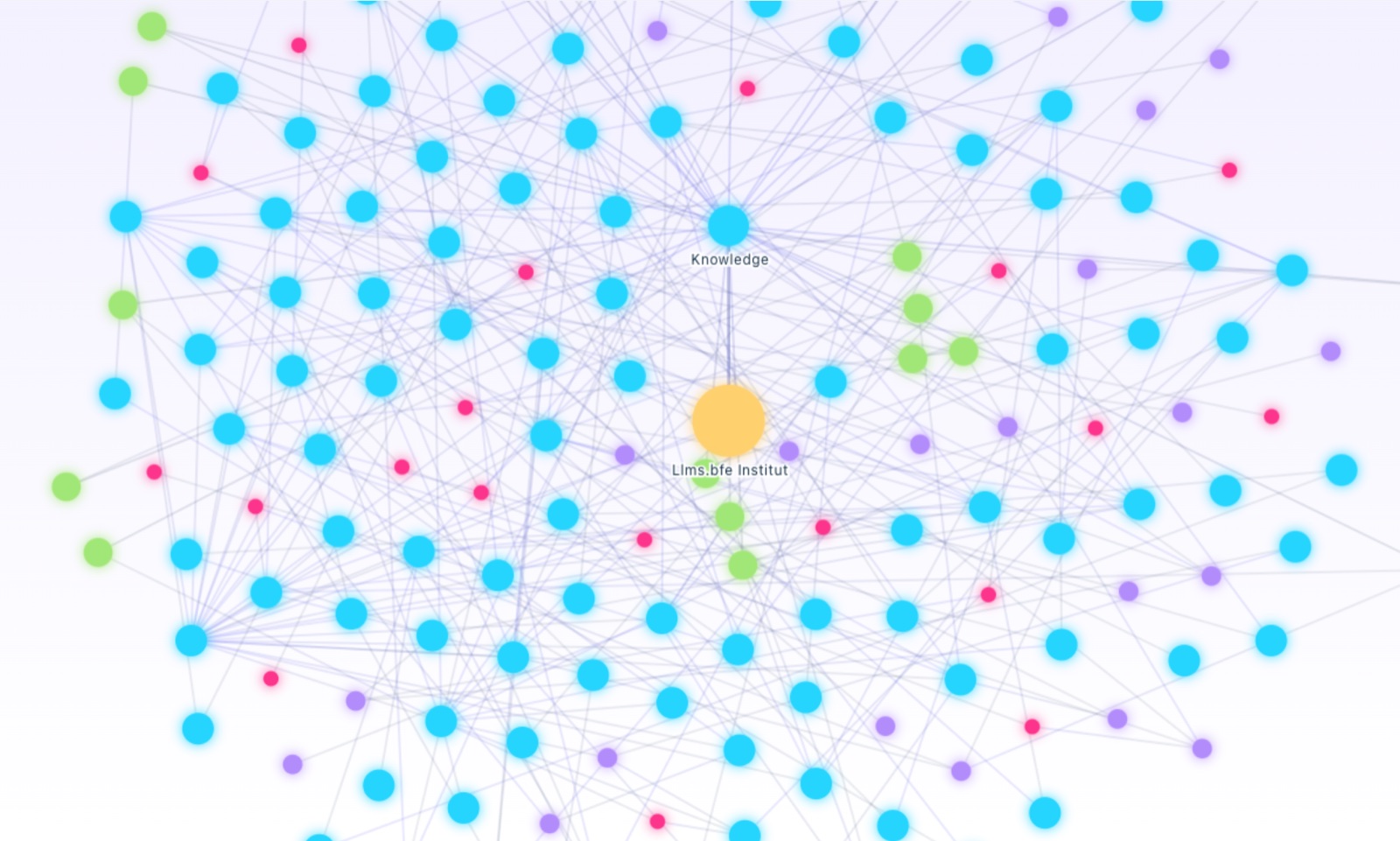
Why Knowledge Graphs Work. Here's the Research.
Machine-readable knowledge measurably improves how AI systems retrieve, ground and cite your facts. Not as a claim, as a result. Here is the mechanism, the specific risks it removes, the peer-reviewed evidence, and what the same effect looks like in our own production data.
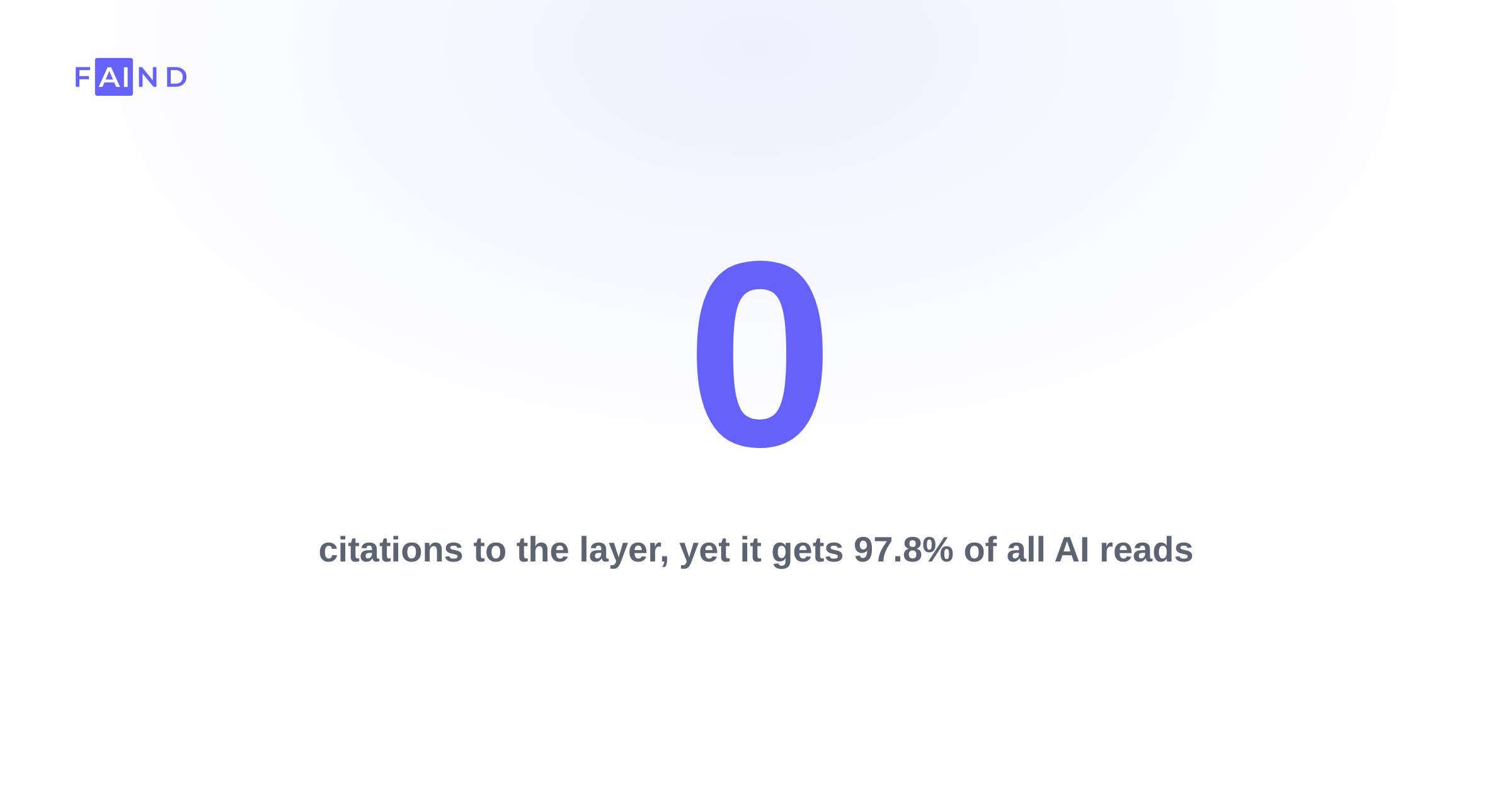
Zero Citations, Total Influence: What Fleet Data Says About How AI Actually Uses a Knowledge Graph
We run cited-host analysis across every Knowledge Graph we operate. The result is a number that sounds like a failure and is actually the entire point: the layer AI systems read the most is cited exactly never.