
Build Your Monitoring Prompt Library (the Free Way)
Before you spend a single euro or engineering hour on AI visibility, you need to know what the machines currently say about you, measured properly, not screenshot by screenshot. This is the complete monitoring methodology from Part I of our GEO masterclass, written so a team with a spreadsheet and three browser tabs can run it this week.
Why your spot check lied to you
Most companies' AI-visibility knowledge consists of one moment: someone asked ChatGPT about the category, the company didn't appear (or did), a screenshot went to Slack, and a conclusion was drawn.
That conclusion is worthless, for one structural reason: identical prompts produce substantially different answers run to run. Ask the same buying question five times in fresh conversations and you'll watch brands appear, vanish, and swap positions. The myth that "ChatGPT always answers the same" dies on first contact with repetition. A single answer is one draw from a probability distribution, and the distribution, not the draw, is what you're trying to move. Measuring it takes the same discipline as any sampling problem: fixed instruments, repeated measurement, controlled conditions.
The anatomy of a useful prompt
The instrument is the prompt, and most first attempts fail the same way: they ask what the company wants to know ("What do you think of Acme GmbH?") instead of what a buyer actually asks. A buyer never names you, if they knew you, they wouldn't be asking.
A monitoring prompt has three layers, and reads like a real question:
"I'm looking for an industrial dosing pump for aggressive media in a mid-sized chemical plant, it needs ATEX certification and remote diagnostics. Which manufacturer would you recommend?"
Layer one: buyer-niche context, industry, role, use case, decision stage. Layer two: an intent suffix, here, a recommendation ask; elsewhere a comparison, an evaluation. Layer three: location injection where it matters, language and region shape which sources get retrieved, so a DACH brand tests in German with DACH context (and, separately, in English, buyers do both).
The five mandatory rules
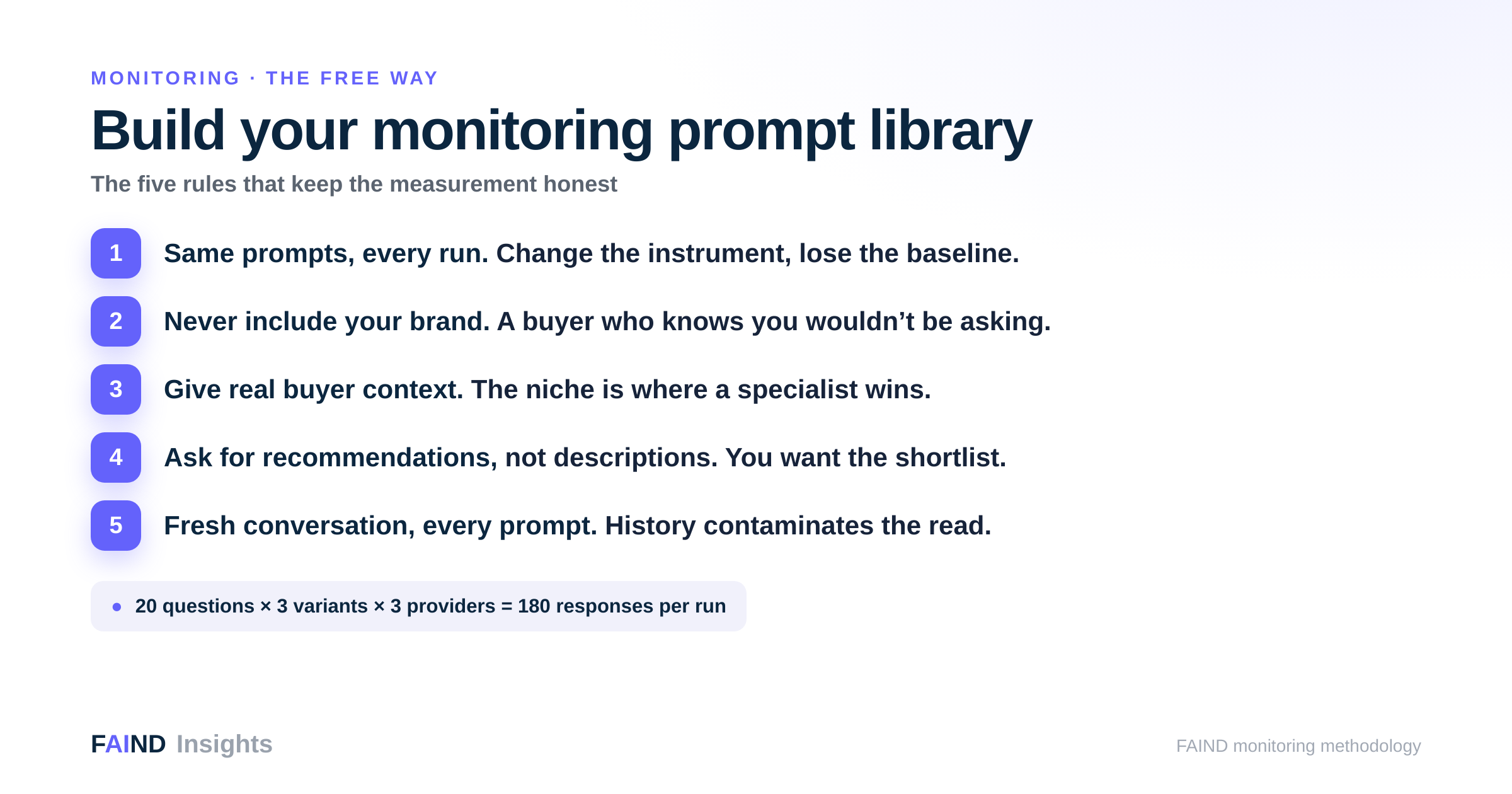
- Same prompts, every run. Change the instrument and you've started a new experiment; you can never again compare against your baseline. Prompt drift is the most common way monitoring programs quietly destroy their own data.
- Never include your brand. No company name, no slogan, no product name, no detail only your marketing uses. The instant your brand appears in the prompt, you're measuring the model's reading comprehension, not your visibility.
- Give real context. Generic prompts get generic answers dominated by generic giants. The niche context is where a specialist can actually win, so test the questions your actual buyers actually have.
- Ask for recommendations. "Tell me about energy management software" produces an essay. "Which would you recommend for X?" produces a shortlist, the thing you're competing for.
- Fresh conversation, every prompt. Chat history contaminates everything downstream. One prompt, one clean session.
The advanced set
Once the basics run monthly, six upgrades separate a real program from a hobby: cover all six intent types (below). Test multiple providers, provider mix varies wildly by field; in our B2B fleet Claude drives 56-74% of recommendations, a fact you'd never learn testing only ChatGPT. Ask the same question several times per run and record the hit rate, not the single outcome. Test small phrasing variations, three per question, so one lucky wording can't flatter you. Query logged out where possible, so personalization doesn't contaminate the read. And prefer the real product surface over bare APIs: the consumer apps run retrieval, safety layers and formatting the API doesn't, and the app is what your buyers actually use.
The six intent types, with examples
A library that only asks "which X is best?" measures one slice of the funnel. Buyers ask six kinds of questions; your library should too. For our fictional dosing-pump manufacturer:
- Discovery, "What types of dosing pumps exist for aggressive chemical media?" (Does the AI's map of the category contain your territory at all?)
- Information, "How do I size a dosing pump for a continuous chlorine dioxide process?" (Are you present where buyers learn, the long-tail authority layer?)
- Recommendation, "Which dosing pump manufacturer would you recommend for a mid-sized chemical plant needing ATEX certification?" (The shortlist question.)
- Comparison, "[Competitor A] vs. [Competitor B] dosing pumps, which is better for water treatment?" (Run it for competitor pairs without your name and see if you get volunteered, the strongest visibility signal there is.)
- Use case, "Which pump handles 40% sodium hydroxide at variable flow rates with remote monitoring?" (Spec-level matching, where precision beats brand size.)
- Evaluation, "Is [your brand] a trustworthy supplier for industrial dosing systems?" (The one place your name belongs in a prompt: measuring what the machine believes when a buyer checks you out.)
Twenty questions across these six types, three variants each, is the standard library. It fits on one spreadsheet tab.
What to record
Per prompt, per provider, per run: whether your brand was mentioned, whether your domain was cited as a source, whether you were actively recommended, which competitors appeared, and the answer's tone toward you. Paste the raw answer alongside, future you will want it. Month over month, those columns become mention rate, citation rate, recommendation rate and share of voice: the four numbers this entire discipline runs on. (Why those four aren't interchangeable is its own article.)
Tools, honestly compared
| Approach | Cost | Fits | |---|---|---| | Manual, spreadsheet + 3 AI tabs | €0 | Getting started, smaller brands, proving the case internally | | SISTRIX AI Monitor | from ~€200/month | Established SEO teams extending their stack | | Peec.ai, Profound | from ~€300/month | Dedicated GEO monitoring focus | | FAIND | €0, included | Teams that want measurement and the implementation layer that moves it |
The manual route is genuinely viable, everything above works with patience and a spreadsheet, which is exactly why we teach it. Its real cost is discipline: the value compounds only if the same library runs every month, and that's the part busy teams drop first. Monitoring is the "+1" in our framework precisely because it's the control loop around everything else; automate it or ritualize it, but don't let it lapse.
Your homework
Build the library, 20 questions, six intent types, three variants, and run it this month, then every month, same prompts. If you'd rather start from a validated baseline than a blank sheet: the free AI Visibility Audit includes a prompt library built to these rules for your specific category, plus your first full measurement across ChatGPT, Claude and Google AI Overviews.
Sources: FAIND monitoring methodology as taught at the DLG-Marketing Day 2026 masterclass; FAIND fleet monitoring standards (180 responses per run: 20 questions × 3 variants × 3 providers).
More in GEO Observations
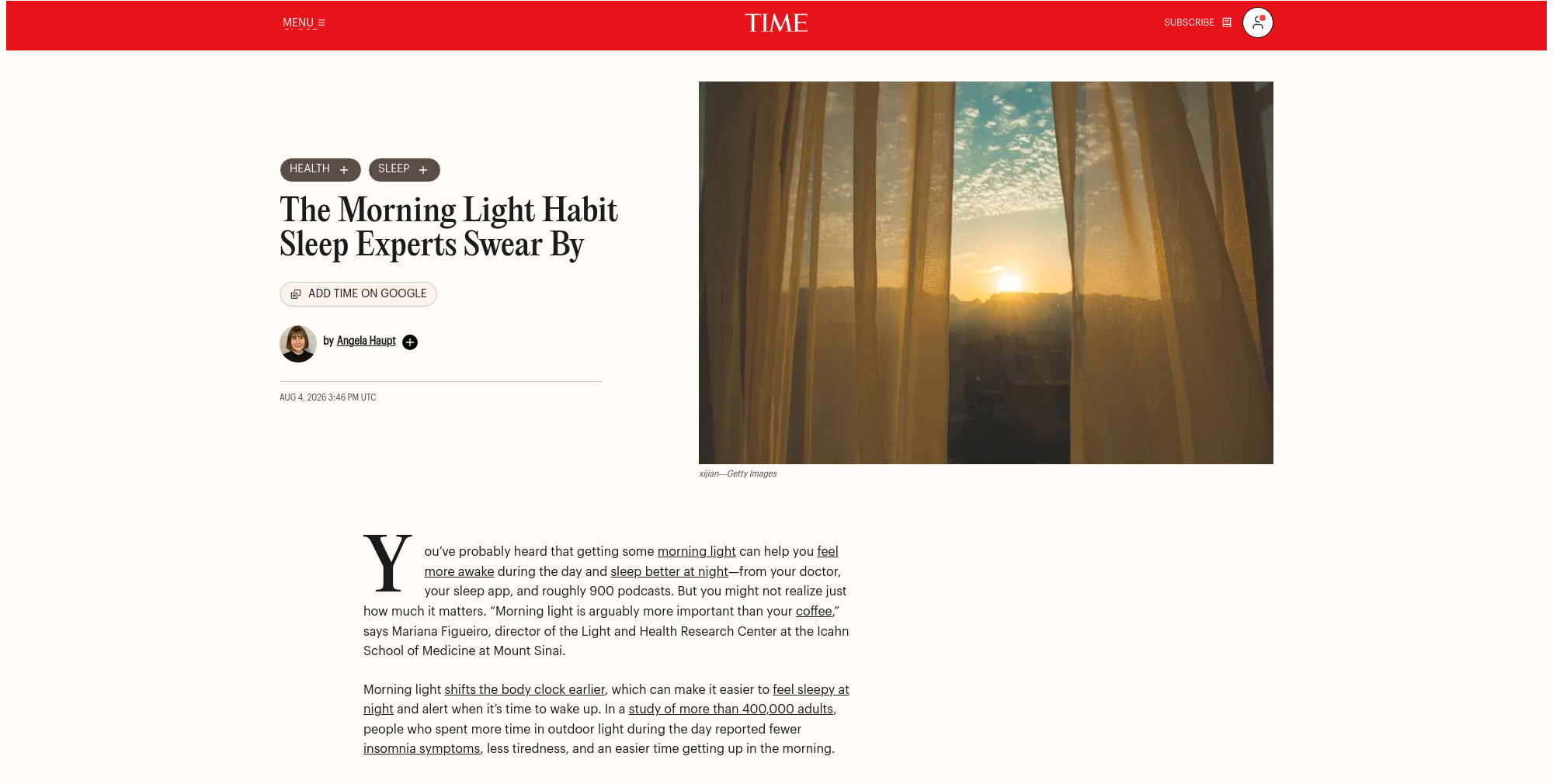
TIME Magazine Turned Prompt Injection Into an Ad Product - Brilliant and Dangerous
Prompt injection is supposed to be an attack on a publisher. TIME made it a line item. Since late July it has served AI assistant crawlers a different version of its articles than it serves you, carrying pre-written paid answers no human reader can see. We reproduced it on 13 August 2026. Brilliant, and dangerous, and not for the reasons most people are giving.
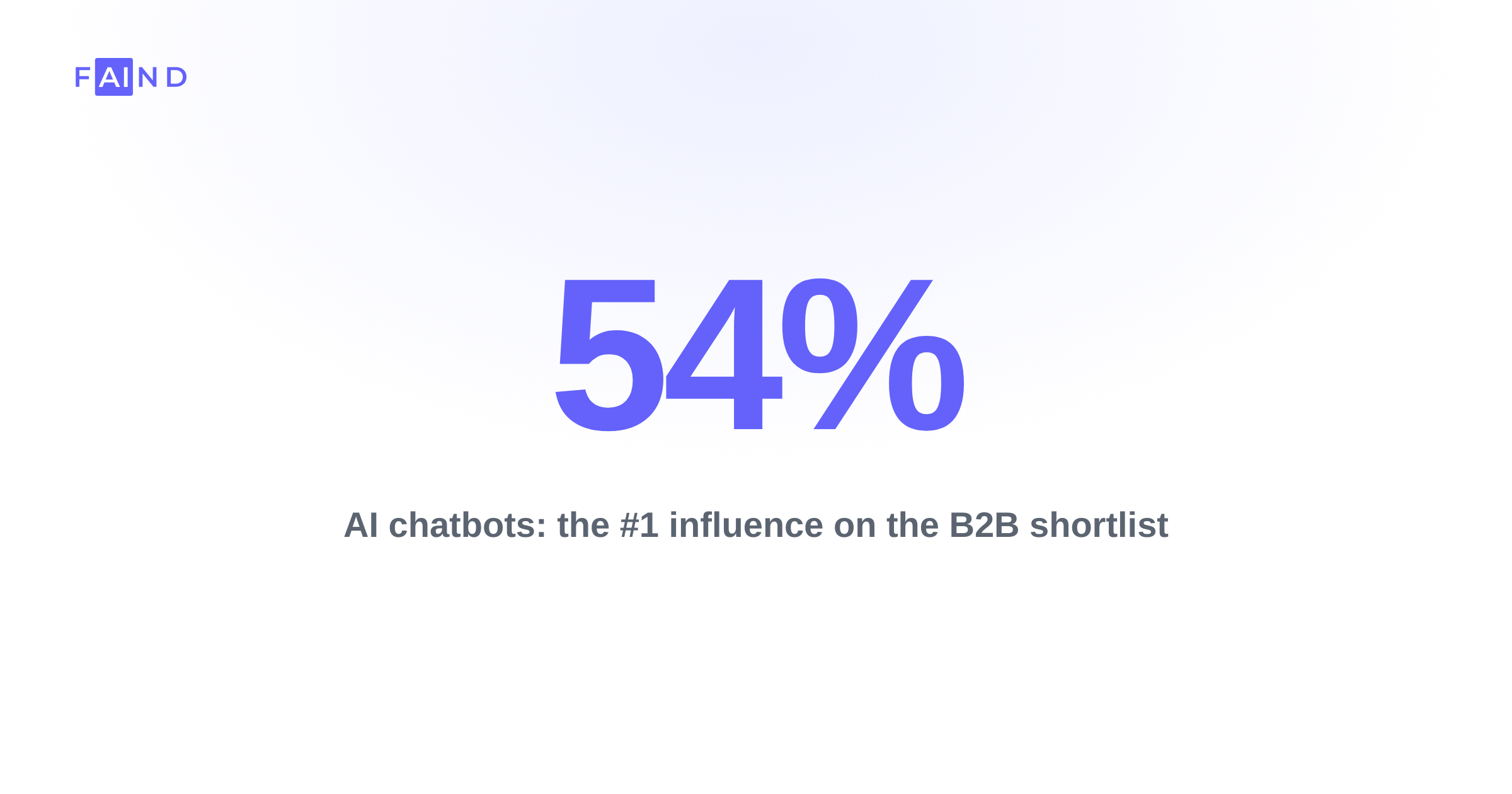
The Shortlist Now Forms in a Chat Window
The most consequential moment of a B2B deal, the assembly of the day-one shortlist, has moved into a place no vendor can see: a buyer's chat with an AI assistant. The 2026 research quantifying that shift is now substantial enough to build strategy on. Here's the evidence, and what it rewards.
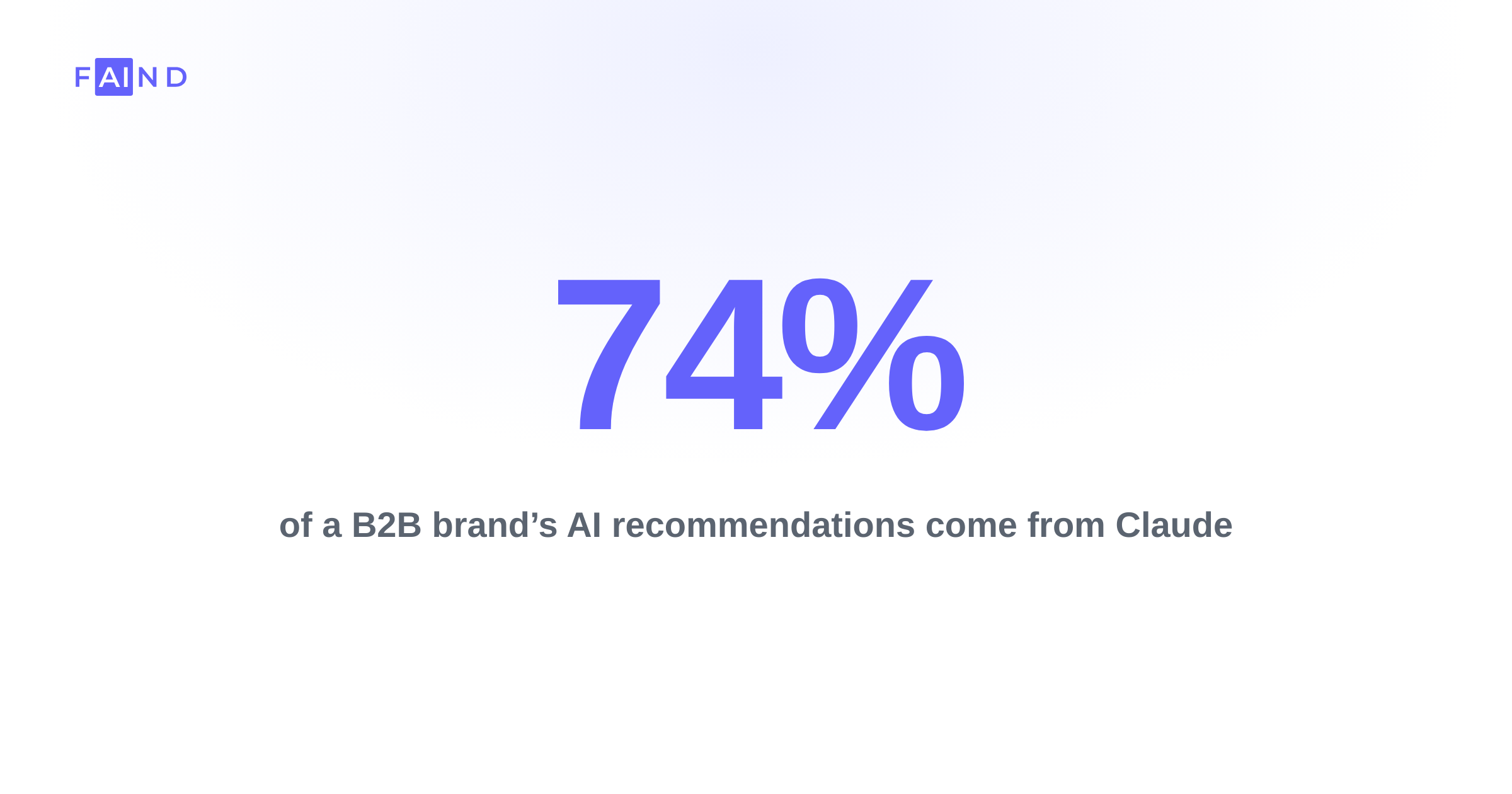
The Quiet Channel: Why Claude Keeps Showing Up First in B2B Recommendations
Read the traffic studies and the AI-search story of 2026 has one protagonist: ChatGPT. Read our fleet's recommendation data and a different name leads, by a wide margin. Both datasets are right. They're measuring different markets.