The Shortlist Now Forms in a Chat Window
The most consequential moment of a B2B deal, the assembly of the day-one shortlist, has moved into a place no vendor can see: a buyer's chat with an AI assistant. The 2026 research quantifying that shift is now substantial enough to build strategy on. Here's the evidence, and what it rewards.
The numbers, from four independent sources
Forrester, 2026 Buyers' Journey Survey (~18,000 business buyers): 94% used AI during their most recent purchase, up from 89% a year earlier. 55% compared vendors inside AI tools, 54% researched products there, 47% built internal business cases with AI, all before any vendor contact. AI answer engines now rank as the number-one vendor research source, ahead of vendor websites, sales reps and product experts. Companies report traffic declines of 10-40% as research migrates into answer engines.
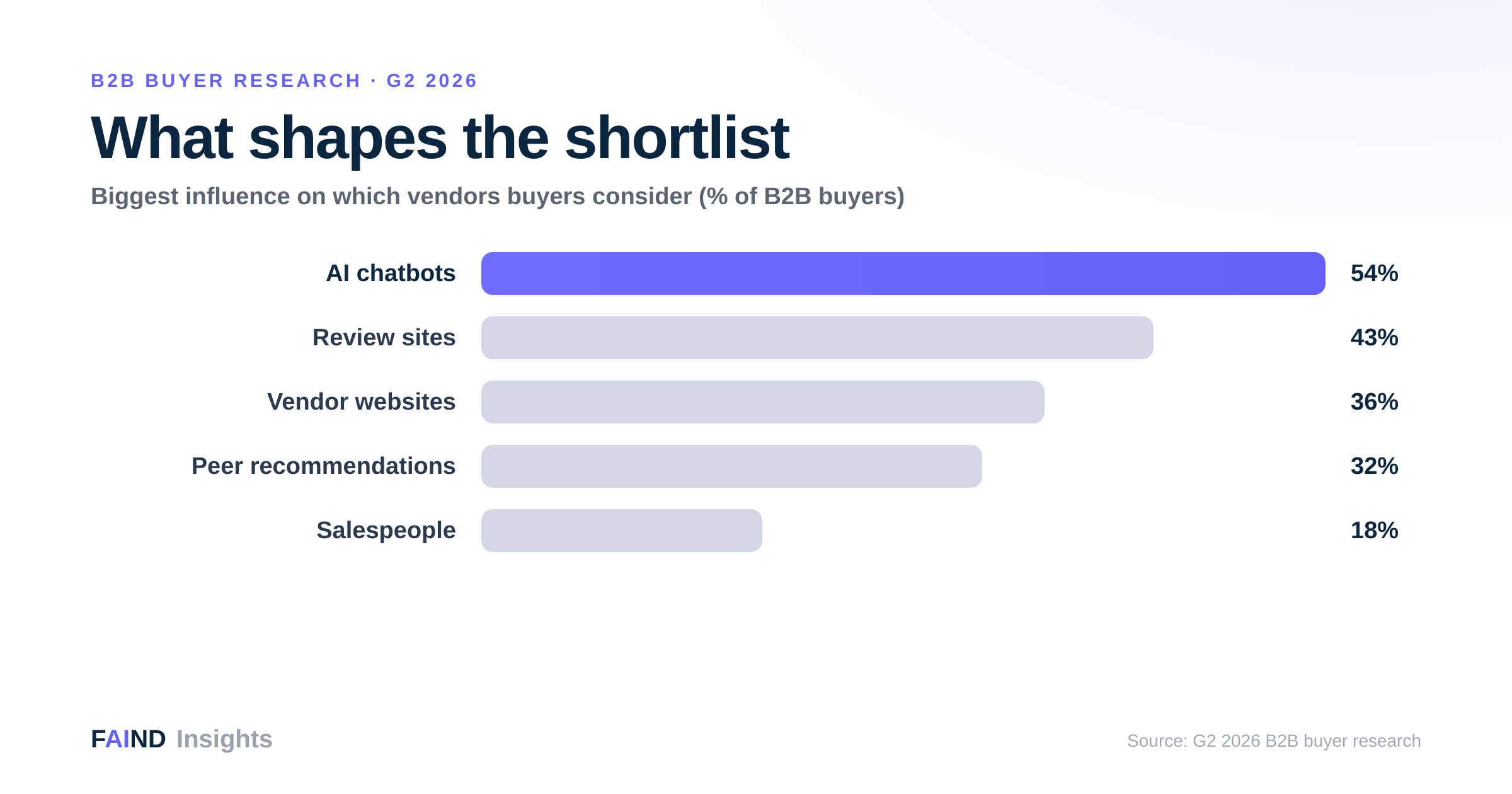
G2, 2026 buyer research: 51% of B2B software buyers now start research in an AI chatbot more often than in Google, up from 29%. And AI chatbots are the single biggest influence on which vendors make the shortlist, cited by 54% of buyers, ahead of review sites (43%), vendor websites (36%), peer recommendations (32%) and salespeople (18%). G2's framing: buyers have moved "from reference to inference", instead of gathering sources and synthesizing themselves, they ask for the shortlist in one prompt.
Semrush, March-April 2026 survey (622 US B2B professionals using AI): 92% say AI has shaped their vendor shortlist, 45% significantly. 75% trust AI vendor recommendations, though nearly all verify before committing. And the detail that should reorganize your positioning work: only 7% notice a vendor in an AI response because they recognize the name. What makes a vendor stand out is how precisely it matches the stated use case.
6sense, Buyer Experience research: 95% of deals are won by a vendor that was already on the buyer's day-one shortlist. Combine with Gartner's long-standing finding that buyers spend roughly five hours in independent research for every hour with any vendor, and the shape is clear: the deal is substantially decided before the first conversation, and the deciding research now runs through AI.
What changed, structurally
Three properties of this shift matter more than the headline percentages:
It's invisible to you by default. The old research phase left traces, your analytics saw the visits, your content saw the downloads, retargeting saw the cookies. A shortlist assembled in ChatGPT or Claude generates none of that on your side. The 10-40% traffic declines Forrester reports aren't demand disappearing; they're demand going dark. You still exist in the process exactly as much as the AI's answer says you do.
It's a two-step trust process, and both steps are addressable. Buyers use AI to determine the consideration set, then verify through peers, reviews and your own materials before committing. Step one is won by being retrievable, extractable and corroborated at answer time. Step two is won by having the answer hold up when a human checks, review profiles, references, substance. Neither step is won by the tactics most B2B marketing budgets still fund first.
Name recognition has stopped carrying the weight it used to. Seven percent. If buyers noticed vendors by brand familiarity, incumbents would own every AI shortlist and the game would be over. Instead, the assistant re-litigates the category on every prompt, matching stated needs against extractable claims. That is structurally the best news a specialist has had in years, if the specialist's substance is legible to the machine doing the matching.
The Mittelstand reading
For the mid-sized industrial and B2B companies we work with, this data resolves a strategic question that used to be depressing: how do you out-market Siemens, SAP or Schneider Electric on a fraction of the budget? Answer: on this surface, you mostly don't have to. The model doesn't weight share-of-voice in trade advertising; it weights whether it can find, parse and trust specific claims matching a specific buyer's context. Our econ solutions case is that thesis in numbers, a specialist moving from a 3.9% to a 27.5% mention rate in 90 days and overtaking 14 of 20 tracked competitors, most of them larger.
The same mechanism cuts the other way, of course. If your better product is locked inside a JavaScript-rendered site the retrieval systems can't read, the assistant will confidently recommend a worse-fitting competitor whose facts were simply easier to extract. The buyer never knows what they didn't see. That is the actual competitive stakes of machine readability, not traffic, shortlist presence.
What to do this quarter
- Find out if you're on the shortlists at all. Run your category's real buying questions, with buyer context, without your brand name, across ChatGPT, Claude and Google AI Overviews. Monthly, same prompts. (Our masterclass framework has the full prompt methodology.)
- Audit the verification step. When a buyer checks the AI's suggestion of you: what do G2, the trade press, Reddit and your own site show? Third-party corroboration drives both steps.
- Make your use-case fit machine-legible. The 7% number means positioning precision beats brand volume. The specifications, certifications, integrations and segment fit that make you the right answer must exist somewhere a retrieval system can extract in milliseconds.
The free AI Visibility Audit answers point one for you across all three providers, it's the same baseline every case study on this blog started from.
Sources: Forrester 2026 Buyers' Journey Survey (~18,000 buyers) and February 2026 traffic-impact reporting; G2 2026 buyer research; Semrush, "How AI tools shape the B2B buying process" (n=622, March-April 2026); 6sense Buyer Experience Report; Gartner B2B buying time-allocation research; FAIND fleet data.
More in GEO Observations
TIME Magazine Turned Prompt Injection Into an Ad Product - Brilliant and Dangerous
Prompt injection is supposed to be an attack on a publisher. TIME made it a line item. Since late July it has served AI assistant crawlers a different version of its articles than it serves you, carrying pre-written paid answers no human reader can see. We reproduced it on 13 August 2026. Brilliant, and dangerous, and not for the reasons most people are giving.
The Quiet Channel: Why Claude Keeps Showing Up First in B2B Recommendations
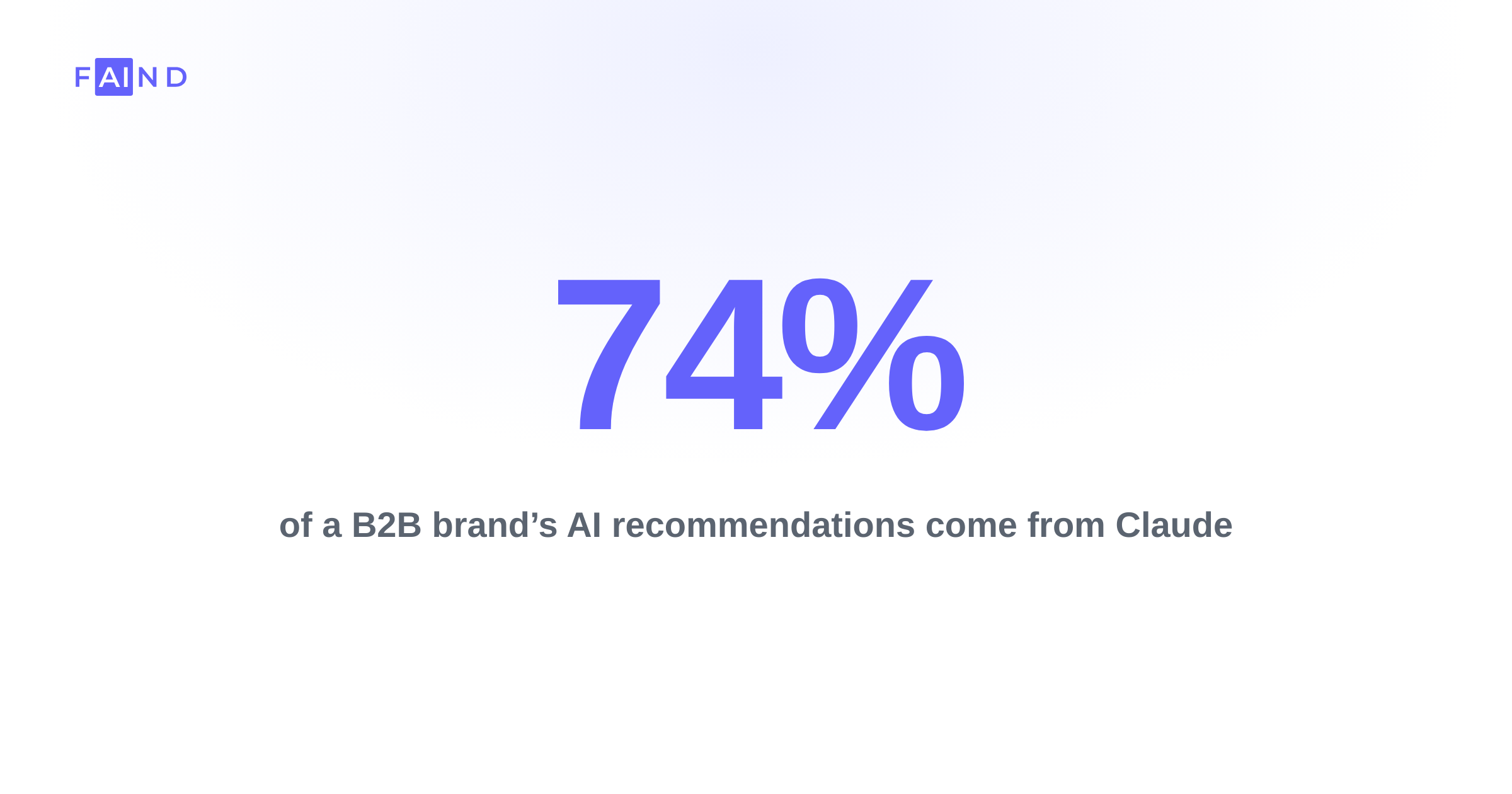
Read the traffic studies and the AI-search story of 2026 has one protagonist: ChatGPT. Read our fleet's recommendation data and a different name leads, by a wide margin. Both datasets are right. They're measuring different markets.
Google Says GEO Is Just SEO. Read the Fine Print.
On May 15, 2026, Google published its first official guide to optimizing for generative AI features in Search, and used it to dismiss half the GEO industry's tactic list by name. A month later it added a pointed clarification on llms.txt. Most of the guide is correct. All of it is scoped. The scope is the story.