
Read 10,000 Times, Clicked Once: The New Economics of Being Crawled
This June, Cloudflare's CEO shared the statistic of the year: bots now generate 57.5% of HTML web traffic, the crossover arrived a year ahead of his own forecast. Underneath it sits a ratio that's reorganizing how the web thinks about AI crawlers. Most of the commentary reads it as a publisher's tragedy. For a B2B brand, it describes something closer to the opposite.
The ratio
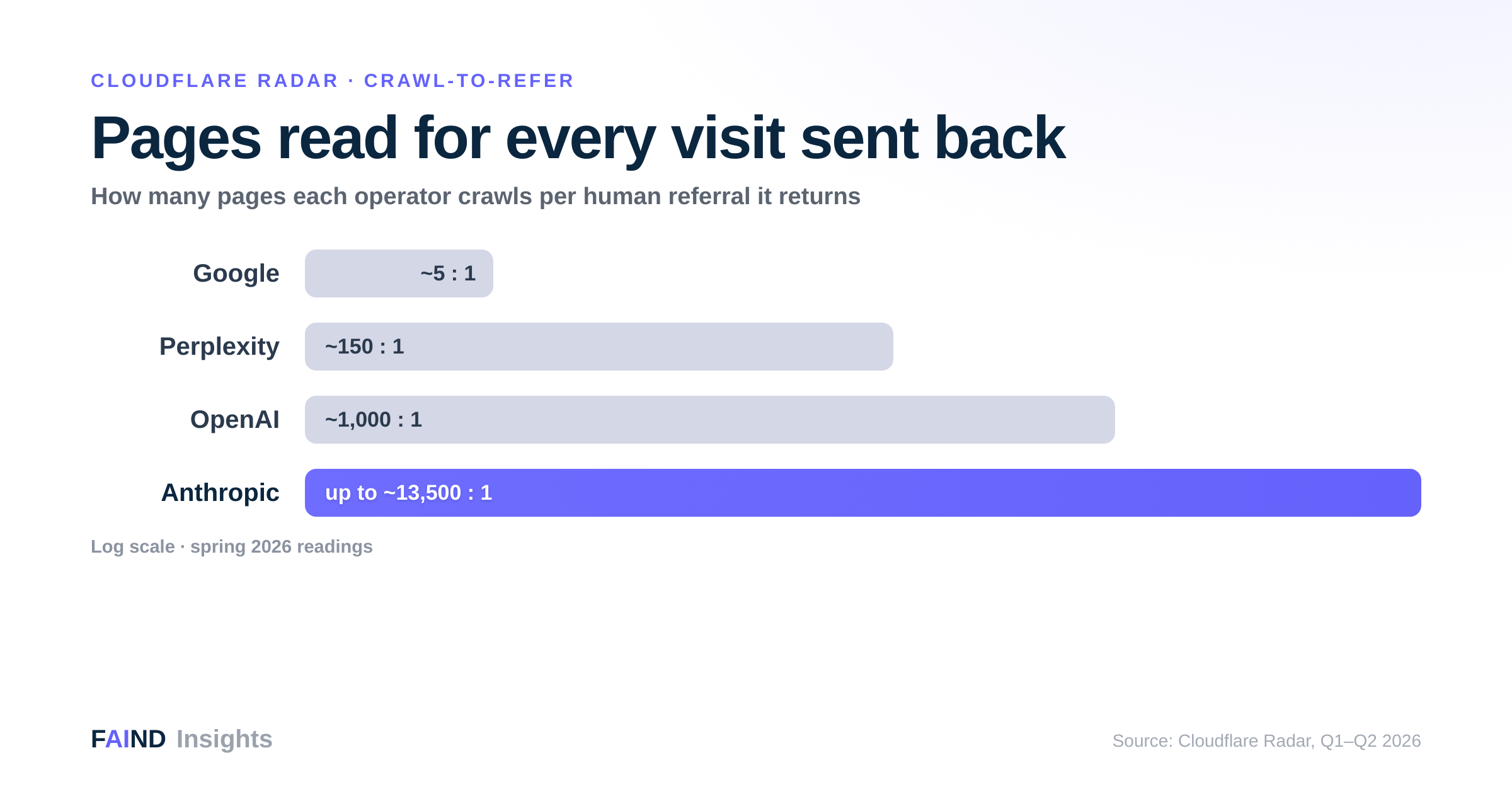
Cloudflare Radar now publishes a metric called crawl-to-refer ratio: how many pages an AI operator's bots fetch from the web for every one human visit the operator's products send back. The spring 2026 readings, which bounce around week to week but hold their shape:
- Google's classic Googlebot: ~5:1. The old bargain of the open web, you grant crawl access, you receive visitors.
- Perplexity: roughly 100-200:1. The friendliest of the AI operators, by an order of magnitude.
- OpenAI: ~850-1,250:1 across recent windows, improving.
- Anthropic: the extreme of the distribution, readings across spring windows ranging from ~4,600:1 to ~13,500:1 depending on the week, improving as its dedicated search crawler grows.
Layer in Cloudflare's crawl-purpose data and the picture sharpens: the training share of AI crawler requests climbed toward half over the first six months of 2026, dedicated search-purpose crawling, the kind that grounds live answers and can produce a citation, reached roughly 10%, and real-time user-action fetches were a low single-digit share. Meanwhile operators have been splitting their do-everything bots into single-purpose ones, ClaudeBot versus Claude-SearchBot being the clearest example, with the latter now the largest dedicated AI-search crawler on Cloudflare's network.
The publisher's reading, and its limit
If your business model is selling attention on your pages, news, reference content, ad-funded media, the ratio really is a broken bargain: content extracted at scale, minimal traffic returned, bandwidth bills attached. The wave of robots.txt blocking, Cloudflare's crawl-control products, and pay-per-crawl experiments are rational responses for that business model, and the training/search crawler split finally makes surgical policy possible: block the extractors, admit the citers.
But most companies are not publishers. A B2B manufacturer, a software vendor, a specialist consultancy does not monetize page views. Their website exists to make buyers choose them. And for that business model, the same ratio means something entirely different.
The brand's reading: the read is the new impression
Follow the mechanics of a modern AI answer. A buyer asks an assistant a buying question; the assistant fans out searches, fetches candidate sources, reads them, and composes a recommendation. The fetch, the "crawl" in the ratio, is the moment your company's facts either enter the answer or don't. The read is where the influence happens. The click was only ever a proxy for it.
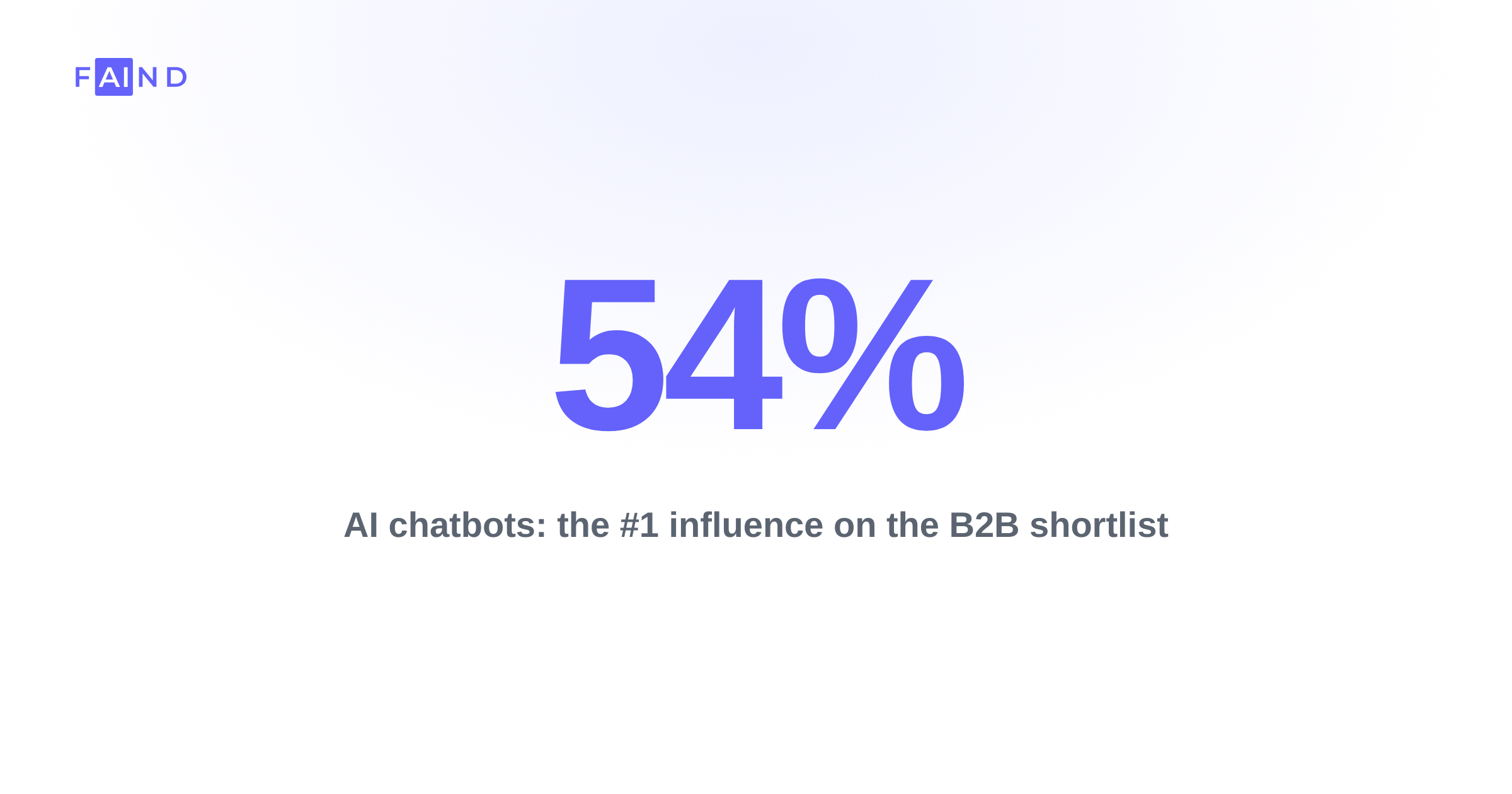
Forrester's 2026 data says 94% of B2B buyers used AI in their last purchase and AI answers are now the top research source; G2 has AI chatbots as the #1 shortlist influence at 54%. Every one of those shortlist decisions was preceded not by a click to a vendor site but by machine reads of whatever sources the assistant could parse. Ten thousand reads per referral isn't extraction without compensation, for a brand, it's ten thousand moments of potential recommendation, compensated in the only currency that reaches pipeline: being the answer.
Our fleet data shows what that looks like when you lean into it rather than fight it. On BFE Institut's domain, 97.8% of 16,502 AI-crawler requests over five months went to the machine-optimized layer we operate for them, which the crawlers chose because it's the cheapest, cleanest read available. Result in the answers: mention rate up 34.7×, #2 share of voice in their field, with all 2,989 checked citations pointing to BFE's own domain. The reads were the asset. The one click-adjacent number that grew, grew for free: brand searches on Google at position 1 with ~50% CTR, because people who meet you in an AI answer come looking for you by name.
Three practical consequences
1. Don't block reflexively, segment. Blanket-blocking AI crawlers to save bandwidth is, for a brand, declining to be considered for shortlists in order to save on the cost of being considered. The defensible policy is purpose-based: decide separately about training crawlers (a genuine trade-off with arguments both ways) and search/user-action crawlers (blocking these removes you from live answers, for most B2B brands, plainly self-harming). The bot split finally makes that distinction enforceable in robots.txt.
2. Serve the reads cheaply, for both sides. If assistants will read you thousands of times per human visit, the economics favor giving them a surface built for it: dense, static, fast, parse-cheap. A 1.5 MB JavaScript application served ten thousand times is a bandwidth bill and a bad grounding input; a machine-readable layer is a rounding error that wins the fetch. (This is, transparently, the architecture we build, but the logic holds whoever implements it.)
3. Re-instrument your measurement. Session-based analytics structurally undercounts a channel whose influence is exercised at read time. The units that track this shift: AI-crawler reads by host and purpose in your logs, and mention / share-of-voice / citation / recommendation rates in the answers themselves. A brand can be winning its category in AI while its referral dashboard shows a flat line, and vice versa.
The uncomfortable version of the conclusion: the click-based contract of the web is ending faster than most measurement stacks and most content strategies assume. The brands that reprice visibility from clicks to reads-and-recommendations now are buying the next distribution channel at pre-consensus prices.
See where your reads and recommendations stand today: the free AI Visibility Audit covers both.
Sources: Cloudflare Radar, bot share of HTML traffic (June 2026), crawl-to-refer ratios and crawl-purpose data (Q1-Q2 2026), as reported by SEOmator, Digital Applied and others; Previsible AI Traffic Report (July 2026); Forrester 2026 Buyers' Journey Survey; G2 2026; FAIND fleet telemetry (BFE Institut, Feb-Jul 2026).
More in GEO Observations
TIME Magazine Turned Prompt Injection Into an Ad Product - Brilliant and Dangerous
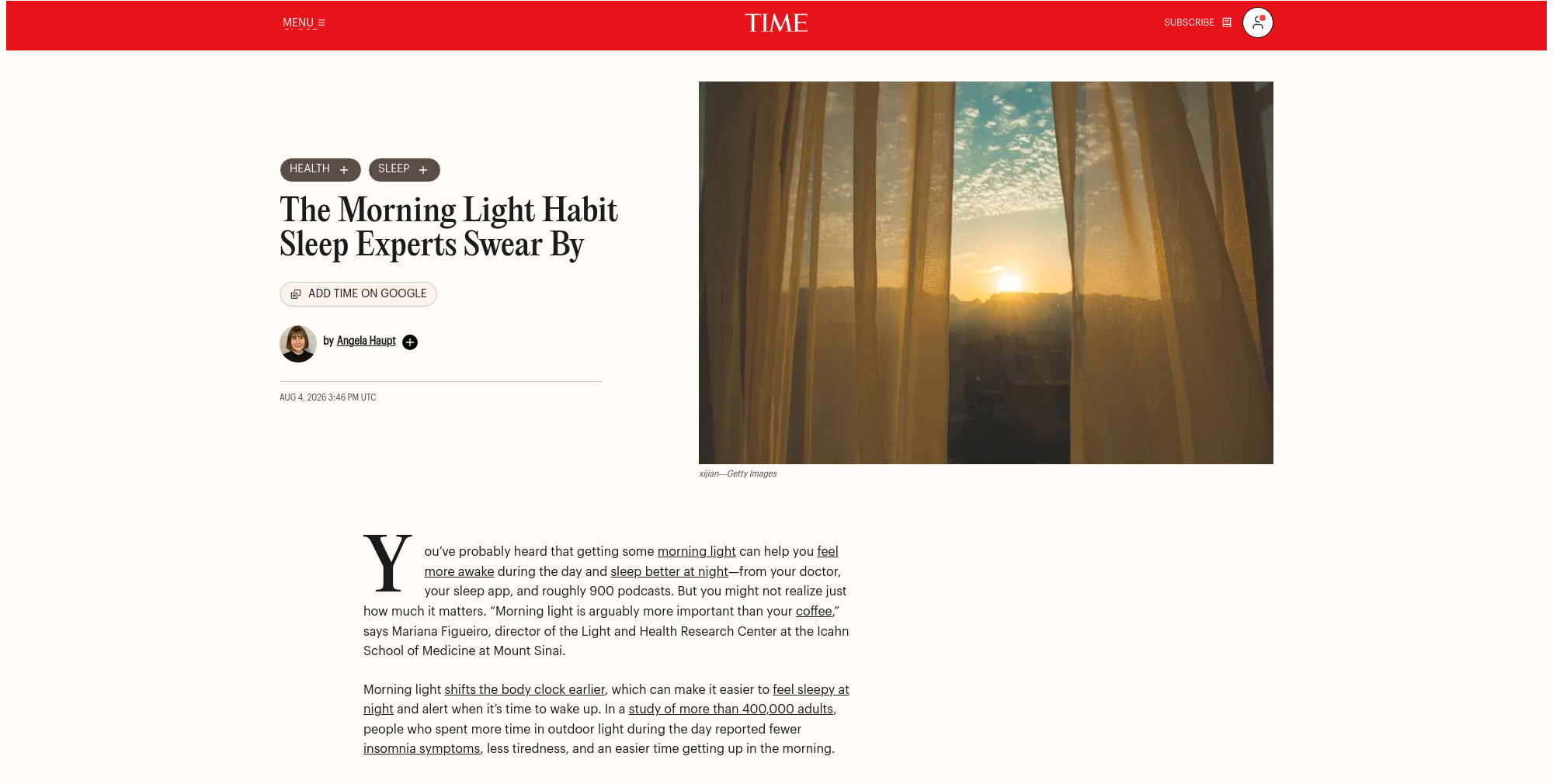
Prompt injection is supposed to be an attack on a publisher. TIME made it a line item. Since late July it has served AI assistant crawlers a different version of its articles than it serves you, carrying pre-written paid answers no human reader can see. We reproduced it on 13 August 2026. Brilliant, and dangerous, and not for the reasons most people are giving.
The Shortlist Now Forms in a Chat Window
The most consequential moment of a B2B deal, the assembly of the day-one shortlist, has moved into a place no vendor can see: a buyer's chat with an AI assistant. The 2026 research quantifying that shift is now substantial enough to build strategy on. Here's the evidence, and what it rewards.
The Quiet Channel: Why Claude Keeps Showing Up First in B2B Recommendations
Read the traffic studies and the AI-search story of 2026 has one protagonist: ChatGPT. Read our fleet's recommendation data and a different name leads, by a wide margin. Both datasets are right. They're measuring different markets.