
The 3+1 Dimensions of GEO: The Full Masterclass, in Writing
On June 9, 2026, FAIND founder Leif Pritzel taught the Generative Engine Optimization masterclass at DLG-Marketing Day in Frankfurt's Klassikstadt, a room full of marketing and sales leads from agribusiness and industrial companies. This is the complete framework from that session: the experiments we ran live, the four disciplines, the myths we retired, and the homework the room took home. If you attended, this is the write-up we promised. If you didn't, it's the whole masterclass, minus the coffee.
Why now: the gatekeeper is being replaced
For twenty years, digital visibility had one gatekeeper. You optimized for Google, Google sent you buyers, and every marketing plan was built on that exchange.
That arrangement is dissolving faster than most planning cycles can absorb. Semrush projects that the majority of search activity is shifting to AI-mediated answers over the course of 2026, with Google's own AI Overviews absorbing much of what remains of the classic results page. The buyer-side data is even blunter: in Forrester's 2026 Buyers' Journey Survey of nearly 18,000 business buyers, 94% used AI during their most recent purchase, and AI answer engines now outrank vendor websites and sales reps as the number-one research source. G2 finds that half of B2B software buyers now start their research in an AI chatbot more often than in Google.
Here is the part that catches most teams off guard: your Google rankings do not transfer. Profound's research comparing what ChatGPT cites against what Google ranks shows the two systems surface largely different top URLs for the same questions. Being on page one of Google and being the brand an AI recommends are two separate achievements, earned through overlapping but distinct mechanics. That gap, between what you've built for the old gatekeeper and what the new one needs, is what Generative Engine Optimization exists to close.
How an AI actually chooses its next word
Before you can influence a system, you need an honest model of how it decides. We opened the masterclass with three live polls, because the fastest way to understand a language model is to briefly become one.
Poll one. "Alle Wege führen nach ___." The room voted, and the room said Rom, near-unanimously. Not because anyone reasoned about Roman infrastructure, but because a lifetime of German exposure makes "Rom" the overwhelmingly probable continuation. That's parametric knowledge: patterns absorbed during training, produced without lookup.
Poll two. "Heute Morgen trank ich meinen Kaffee ___." Suddenly, no consensus, milk, sugar, black, not at all. When training data contains no dominant pattern, the distribution flattens and the answer becomes a coin flip among plausible options. This is precisely the situation of a mid-sized B2B brand inside a language model: the model has no strong prior about you, so absent better input, your appearance in an answer is left to probability.
Poll three. You need to catch a train in ten minutes. Where do you check the platform, the departure board at the station, your ticket, the booking email, your calendar? The room chose the live board, obviously. When information is time-sensitive and consequential, you don't trust what you memorized; you look it up. Modern AI assistants behave the same way: for buying questions, they fan out live web searches mid-answer and ground their response in what they retrieve.
Three polls, three levers. Every AI answer about your brand is assembled from exactly these sources: prior knowledge from training (slow to change, biased toward famous entities), live sources fetched into the context window at answer time (fast, and the one you can realistically influence quarter to quarter), and trust, the model's learned weighting of which sources deserve belief, built from reputation signals across the web.
The experiment that explains everything
The most instructive moment of the masterclass took ninety seconds and involved no technology.
We showed the room ten words, Anker, Wolke, Spiegel, Stern, Pfeil, Münze, Brücke, Nadel, Kerze, Feder, then asked which one stuck. Then we showed the same ten words again, arranged differently: different order, different visual grouping, different emphasis. And asked again.
The votes moved.
Same task. Same amount of information. Different presentation, and a measurably different probability of any given word being selected. Nobody in the room got smarter or dumber between rounds. The only thing that changed was the structure of the input.
That is the entire logic of GEO in one experiment. An AI assistant assembling an answer is performing selection under constraint: limited context window, hard latency budgets, dozens of candidate sources. The faster a signal can be recognized, classified and extracted, the higher the probability it gets selected. Clearer structure, less noise, denser facts, better context, these don't make your company better, but they dramatically change whether the machine picks your version of the facts when the answer is being written.
From this follows a three-hurdle model that every piece of your web presence must clear:
- Get retrieved. Crawlable, indexed, fast to read, backed by external signals. If the fetcher times out or the crawler is blocked, nothing else matters.
- Get selected. Structure, low noise, high fact density. Out of everything retrieved, the model uses what it can extract cheaply and unambiguously.
- Get believed. Freshness, authority, third-party corroboration. Models increasingly weight source trust internally, a claim that exists only on your own site carries less than one echoed by independent sources.
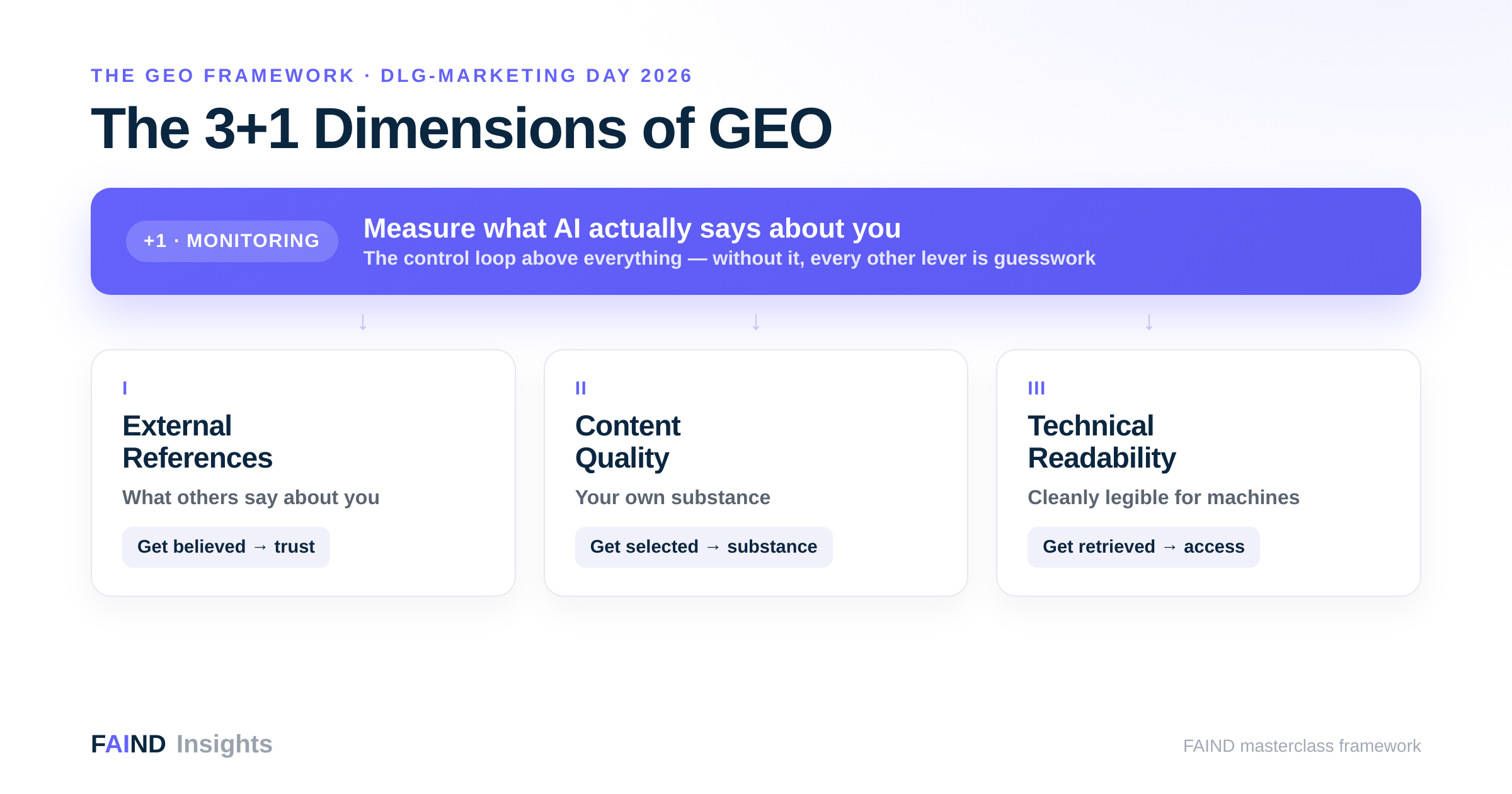
The framework: 3+1 dimensions
Everything practical in GEO sorts into four disciplines. Three are levers you pull. The fourth sits above them, which is why we call it 3+1 rather than 4:
I. Monitoring (the +1, above everything), measure what AI actually says about you. Without it, every other activity is guesswork, and you'll never know which lever moved the number.
II. External References, what others say about you. The trust dimension.
III. Content Quality, your own substance. The selection dimension.
IV. Technical Readability, cleanly legible for machines. The retrieval dimension.
Monitoring is the "+1" because it's not parallel to the others, it's the control loop around them. You can do external references, content and technical work in any mix; without measurement you cannot tell whether any of it worked, and in a field this young, intuition is a poor substitute for data.
Let's take each in the depth the masterclass did, including the myths we retired and the homework each section produced.
I. Monitoring: measure before you move
The instrument of monitoring is the prompt. And most companies get it wrong on the first attempt by asking, in effect, "What do you think of us?", a question no real buyer asks.
A useful monitoring prompt looks like a real buying question: "I'm looking for a BAFA-eligible energy-management software for industrial companies, with an integrated ISO 50001 assistant and vendor-independent meter connectivity. Which brand would you recommend?" Niche context, intent, and, critically, no brand name anywhere in the prompt.
The mandatory rules: always the same prompt, every run. Never include your company name, slogan, or any identifying detail. Give buyer context (industry, role, location where relevant). Ask for recommendations, not descriptions. Start a fresh conversation every time, chat history contaminates results.
The advanced set: cover all six intent types, discovery ("what types of X exist?"), information ("how do I do X?"), recommendation ("which X is recommended?"), comparison ("X vs. Y, which is better?"), use case ("which X handles Y?"), evaluation ("is X trustworthy?"). Test multiple AI providers. Ask the same question several times, and test small variations. Query logged out where possible, and prefer the real product surface over bare APIs, because that's the surface your buyers actually hit.
Myth retired: "ChatGPT always gives the same answer." It doesn't, responses to identical prompts vary substantially run to run. That variance is exactly why single-shot spot checks mislead, and why the same question must be asked repeatedly before you conclude anything.
Tooling, honestly compared: a spreadsheet plus three AI tabs costs nothing and is a legitimate start for small brands. SISTRIX AI Monitor starts around €200/month and fits established SEO teams. Dedicated GEO platforms like Peec.ai or Profound start around €300/month. FAIND includes structured monitoring, mention rate, share of voice, citation rate, recommendation score, refreshed monthly across ChatGPT, Claude and Google AI Overviews, as a standard component of every engagement, because we refuse to optimize what we can't measure.
Homework: build your prompt library, twenty questions with small variations, spanning the six intent types, and run it monthly. (We build this library free as part of our AI Visibility Audit, if you'd rather not start from a blank sheet.)
II. External References: what the machines believe about you
When we traced where an AI actually pulled its information for the energy-software prompt above, the sources were revealing: G2. Reddit. Computerwoche. Wikipedia. Not one of them the vendor's own website.
This is the pattern across B2B: models lean heavily on third-party corroboration. Bain's research puts it starkly, for unbranded B2B questions, roughly nine in ten citations come from sources other than the brand's own domain. The places AI looks are knowable and finite:
- Structural trust sources: Wikipedia and Wikidata, the entity backbone of the web.
- B2B review platforms: G2, Capterra, Trustpilot.
- Trade press (DACH): Computerwoche, t3n, Heise, e3zine and their industry equivalents.
- Community and UGC: Reddit, Quora, LinkedIn, YouTube, and the niche forums of your industry.
- Vertical portals: the specialist directories of your field, in energy, think energie-experten.org; in engineering, the sector portals your buyers already read.
Two myths retired. First: "Backlinks don't matter in the AI world." The opposite, external references are the strongest trust signal a model can read about you; what changes is that mentions and citations in trusted sources now matter alongside classic links. Second: "English sources are irrelevant for the German market." False. ChatGPT and Claude do not think in national borders or languages; a strong English G2 profile or Reddit thread routinely shapes German-language answers.
The hacks that work: get a Wikipedia entry moving if you plausibly qualify. Maintain your profiles on B2B directories and review platforms, and actively invite customers to review. One or two genuine, helpful answers per month on Reddit or Quora, from a real account with history. One employee anchored in your industry's main forum.
Homework: audit your own brand and one competitor across the UGC platforms of your industry, then moderate and maintain regularly. What you find your competitor has and you lack is your priority list.
III. Content Quality: write for the questions AI asks itself
Here's what actually happens when a buyer asks an assistant our energy-software question: the model doesn't run one search. It fans out, expanding the question into several queries of its own: "energy management software manufacturing," "EMS software comparison 2026," "ISO 50001 Software Mittelstand," "best energy management software reviews," "Energiemanagement Software Vergleich."
Look at the words the machine added on its own: 2026, reviews, comparison, best, alternative, vs, Erfahrungen, Test, Vergleich, plus the segment qualifiers of the niche. These fan-out modifiers are the vocabulary of retrieval. Write them into your titles and headings deliberately, and you meet the machine's queries head-on. (Browser extensions now exist that expose the fan-out queries behind AI answers, worth installing for a week just to see your category through the machine's eyes.)
Format matters more than most content teams want to hear. In our observations of B2B answers, list-formatted comparison content, the honest version of the "Top 10 X for Y" page, gets cited on the order of three to seven times more often than narrative brand storytelling. The model is looking for extractable, comparable, rankable structure; a listicle is that structure.
Two myths retired. "More text = better." No, structure beats length, every time; a tight, well-organized 800 words outperforms a meandering 3,000. "AI-generated content gets penalized." Not as such, what gets discounted is content that's structurally messy or factually wrong, regardless of who or what wrote it.
The hacks: publish the Top-10 listicle for your category with your own brand honestly positioned at #1, with real criteria you can defend. Build comparison pages against your named competitors ("econ vs. Siemens," "econ vs. SAP"). Create English versions of your five to ten most important pages, see Myth Two above. Show a visible date and update note on everything. And use the fan-out modifiers in titles, actively.
Homework: pull the fan-outs behind your core buying prompts, check whether you have content that answers each one, and match your headlines to the queries.
IV. Technical Readability: the biggest lever, the least glamorous
We closed with the dimension where the largest effects hide behind the least effort, and demonstrated it live on a real page.
We loaded a customer-story page from econ-solutions.de twice. Once as a human sees it: polished, branded, informative. Once as an AI retrieval system sees it: a client-side-rendered JavaScript application, 1.5 MB of framework code, time-to-content beyond 200 milliseconds. The machine view was an empty HTML shell, <div id="SITE_CONTAINER"></div>, a comment noting that content renders client-side, and then the connection cut before the main content ever loaded.
For the human, a good page. For the machine deciding whether to recommend econ: the page effectively did not exist.
This is not a Wix problem or an econ problem; it's the default condition of the modern web. Retrieval systems operate under hard token and latency budgets. JavaScript-rendered interfaces, sprawling navigation, marketing prose wrapped around scattered facts, all of it is expensive to parse, and expensive content gets truncated, misread or skipped. The three hurdles from earlier all fail at once: not retrieved, not selected, never even considered for belief.
And here is the dilemma we built the whole masterclass around: you cannot fully fix this on your main website without breaking it for its actual job. Your site exists to persuade and convert humans; strip it down to machine-optimal density and you've traded conversion for crawlability. Content, structure and design that serve people and classic SEO are, at the margin, in genuine tension with what makes extraction fast for an LLM.
The clean resolution is separation: let the human site do its job, and give machines a parallel, machine-optimized layer that carries the same verified facts in the structure retrieval systems prefer. That's the architecture FAIND builds, a Knowledge Graph on your own subdomain, deployed with one script, maintained automatically, with every citation and all credit flowing to your original domain. The masterclass wasn't a product demo and neither is this article; the architectural point stands independently of who implements it. But it's worth saying plainly: of the four dimensions, this is the one where a structural fix beats a hundred incremental content tweaks.
The worked example: what 90 days looks like
Throughout the masterclass, one company served as the running example, because their situation is the Mittelstand situation.
econ solutions builds energy-management software for industrial operations. Their competitors in AI answers are Siemens, SAP and Schneider Electric, generalists with global marketing footprints. econ has, by broad consensus of its 850+ customers, the better solution for its target group, and by any measure the smaller megaphone. Before optimization, the numbers said exactly that: mentioned in 3.9% of monitored AI answers. The model had no reason to know better.
Ninety days after deploying a machine-readable layer and working the dimensions above: mention rate 27.5% (7.1×), citation rate 3.3% → 12.5% (3.8×), active recommendations 14.3% → 41.8%, and 19 of 20 tracked competitors now rank behind them in their field. In the same window, the original website's Google clicks rose 5.3× and its average position improved from 21.3 to 12.4. Both channels grew; nothing was traded away. The full case study has every number and the methodology.
The point of the example isn't the multiples. It's the shape of the opportunity: AI answers are currently the most level playing field a specialist has had against incumbents in twenty years, because the model doesn't reward marketing budget, it rewards being the clearest, most verifiable, most extractable source about your niche. That window won't stay open forever.
Your homework for the rest of the week
The masterclass ended with four assignments. They still apply:
- Build your prompt library, 20 real buying questions, six intent types, small variations, and run it monthly. That's your baseline; without it, everything else is anecdote.
- Audit the UGC platforms of your industry for your brand and one competitor. Close the gaps; maintain monthly.
- Map your fan-outs. Pull the queries AI generates for your core prompts and match your titles to them.
- Fetch your own site like a machine, curl it, or load it with JavaScript disabled. Whatever survives is your actual grounding input. For many companies, that single test reorders the entire roadmap.
If you'd rather see your numbers than guess: our free AI Visibility Audit runs your category's real buying questions across ChatGPT, Claude and Google AI Overviews and includes the technical readability scan, the same before-picture every case study above started from.
Sources: DLG-Marketing Day 2026 (June 9, 2026, Klassikstadt Frankfurt), masterclass "Generative Engine Optimization - Sichtbar in KI-Systemen"; Forrester 2026 Buyers' Journey Survey; G2 2026 buyer research; Bain AI search research; Semrush and Profound industry data as presented in the masterclass; FAIND fleet telemetry and the econ solutions case study (observed 16 Jan - 26 Apr 2026).
More in GEO Observations

TIME Magazine Turned Prompt Injection Into an Ad Product - Brilliant and Dangerous
Prompt injection is supposed to be an attack on a publisher. TIME made it a line item. Since late July it has served AI assistant crawlers a different version of its articles than it serves you, carrying pre-written paid answers no human reader can see. We reproduced it on 13 August 2026. Brilliant, and dangerous, and not for the reasons most people are giving.
The Shortlist Now Forms in a Chat Window
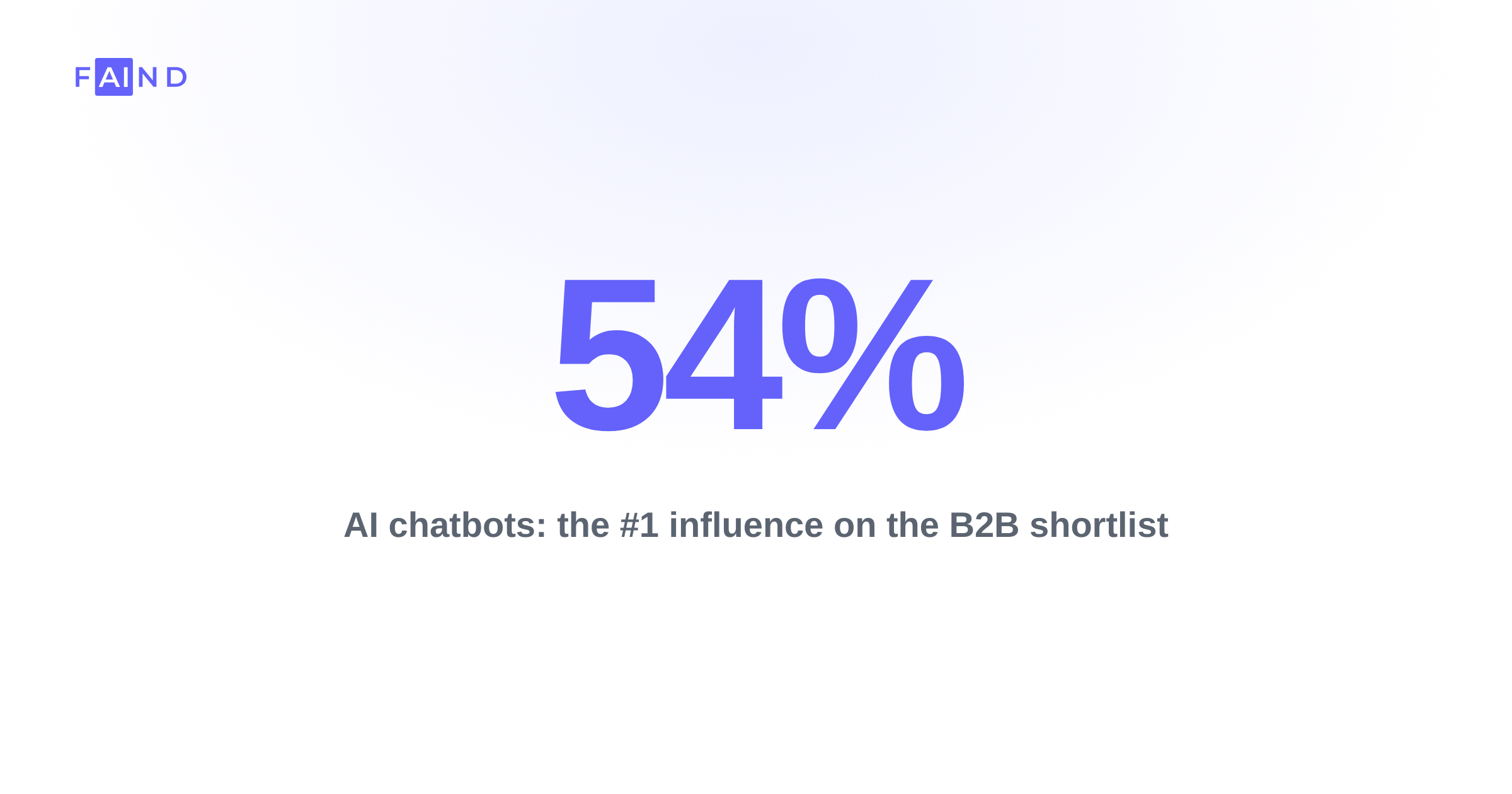
The most consequential moment of a B2B deal, the assembly of the day-one shortlist, has moved into a place no vendor can see: a buyer's chat with an AI assistant. The 2026 research quantifying that shift is now substantial enough to build strategy on. Here's the evidence, and what it rewards.
The Quiet Channel: Why Claude Keeps Showing Up First in B2B Recommendations
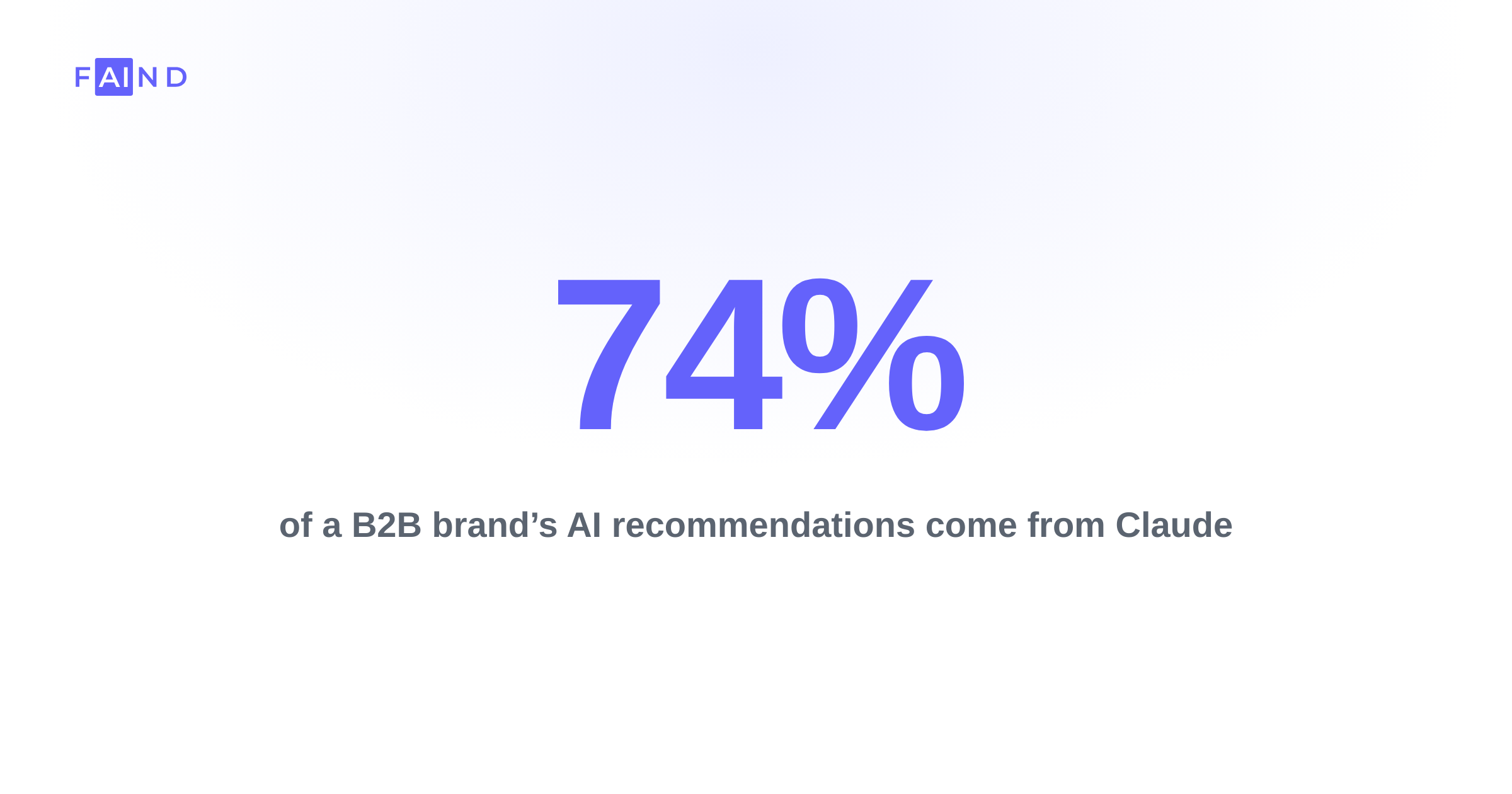
Read the traffic studies and the AI-search story of 2026 has one protagonist: ChatGPT. Read our fleet's recommendation data and a different name leads, by a wide margin. Both datasets are right. They're measuring different markets.