The Five SEO Worries, Audited
Every serious conversation about adding an AI-readable layer to a company's web presence surfaces the same five objections, usually from the SEO team, and usually for good reasons. They deserve better than reassurance. This page states each worry at full strength, explains the mechanism that prevents it, and shows the audit data from four months of the hardest test we could run: a full website replatform with the layer live from week one.
The test bed throughout is our BFE Institut deployment, relaunch and Knowledge Graph live in the same month, February 2026, observed through June. If any of the five failure modes were going to appear, that setup is where they'd appear first and worst. Bookmark this page; it exists so these arguments only need to be made once.
Worry 1: "Duplicate content will hurt us."
The worry, stated fairly. The layer carries the same facts as the website, restructured. Google has spent two decades teaching everyone that duplicated content splits ranking signals, wastes crawl budget, and at scale looks like manipulation. Publishing a parallel copy of your site sounds like volunteering for exactly that.
The mechanism. Three properties defuse it. The layer lives on its own subdomain (llms.your-domain.com), a clearly separated host, not intermingled with the main site's URL space. Every layer page that overlaps a page on the original site carries a canonical tag pointing at the original, which tells Google explicitly: that page is the authoritative version, consolidate all signals there. And the layer's content isn't a copy in the first place, it's a machine-optimized restructuring, which combined with the canonicals means the original site remains the single source of truth in Google's index. (The full logic of which pages defer and which stand alone is in our canonical-policy article, worth reading if your SEO team wants the edge cases.)
The audit. Four months, spanning a replatform: clean indexing throughout, Google impressions and clicks to bfe-institut.com growing month over month, impressions trend around +18%.
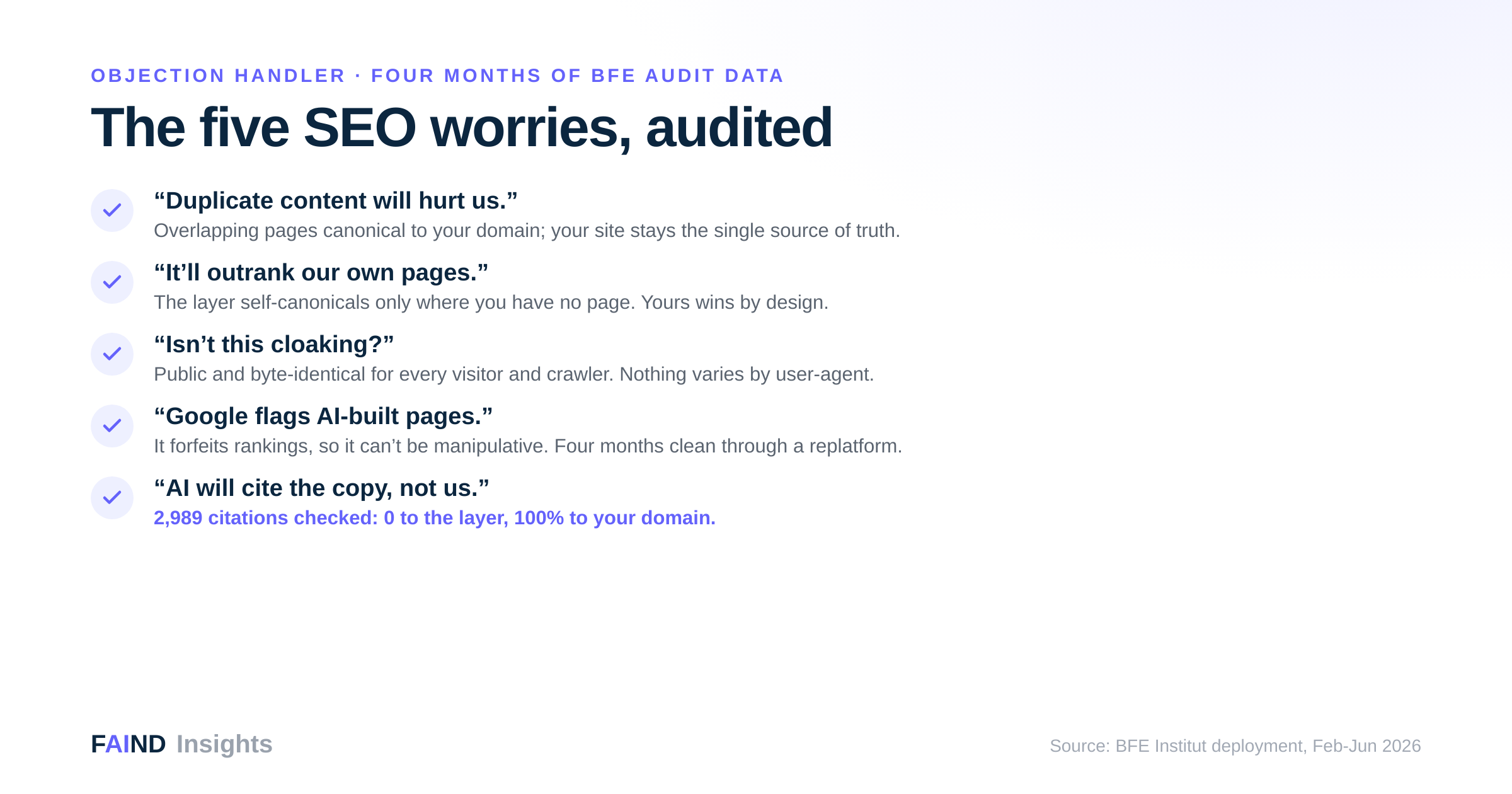
For procurement: Overlapping pages canonical to the original domain; the main site stays the single source of truth.
Worry 2: "It'll outrank our own pages."
The worry, stated fairly. A layer built specifically to be maximally machine-legible might be too good, Google could start preferring it, and suddenly your polished product page loses its ranking to your own plumbing.
The mechanism. This one is prevented structurally, not probabilistically. Wherever your site has a page, the layer's version canonicalizes to it, the layer voluntarily hands over the ranking before any competition can start. The layer is only self-canonical where your site has no page at all, meaning it can only ever add search footprint you didn't have, never contest footprint you did.
The audit. Four months, zero ranking conflicts. Not "few", zero. Where BFE's site has a page, BFE's page wins by design; the layer ranked only where BFE previously had nothing.
For procurement: Where your site has a page, yours wins by design; the layer only ranks where you had none.
Worry 3: "Isn't this cloaking?"
The worry, stated fairly. "A version for machines, a version for humans" is uncomfortably close to how cloaking gets described, and cloaking is one of the few things Google penalizes without much conversation.
The mechanism. Cloaking has a precise definition: serving different content to crawlers than to human visitors at the same URL, varied by user-agent, to deceive. The layer does the opposite on every element of that definition. It's a set of public URLs, reachable by anyone, serving byte-identical content to every visitor and every crawler. Nothing anywhere varies by user-agent. A human can open llms.bfe-institut.com in a browser right now and read exactly what ClaudeBot reads. Two honest versions at two honest addresses isn't cloaking, it's the same principle as offering a PDF datasheet alongside a product page.
The audit. Fully public layer, four months of crawler access from Google and every AI operator, no manual actions, no spam flags, clean indexing.
For procurement: The layer is public and identical for every visitor and crawler; nothing varies by user-agent.
Worry 4: "Google flags AI-built pages."
The worry, stated fairly. Google's spam policies explicitly target scaled, automatically generated content. An automatically generated and maintained layer of hundreds of pages sounds like a textbook match.
The mechanism. Read the policy's actual target: content generated at scale for the purpose of manipulating search rankings, pages built to intercept queries and rank. The layer is disqualified from that category by Worry 2's mechanism: on every contested term it forfeits the ranking to the original site via canonical. You cannot manipulate rankings you structurally refuse to compete for. What remains is machine-readable reference material about a real company's real products, closer in kind to a sitemap or a data feed than to an AI content farm. Google's own May 2026 generative-AI guidance points the same direction: its concern is manipulative intent and thin substance, not automation per se.
The audit. Four months live through a replatform, the moment of maximum algorithmic scrutiny, with clean indexing and growth every month.
For procurement: Google's policy targets pages built to game rankings; the layer doesn't compete for them. Four months live: clean indexing, monthly growth.
Worry 5: "AI will cite the copy, not us."
The worry, stated fairly. If assistants read the layer instead of the website, the layer becomes the visible source, your subdomain-plumbing gets the citations, the clicks, and the brand association, while your actual site fades. Visibility, yes; your visibility, no.
The mechanism. The layer is shaped as a grounding input, not a destination: unambiguous entity resolution pointing at the customer's canonical identity, hosted on the customer's own domain family, with overlapping content deferring to the originals. Assistants read it to assemble the answer, then attribute the facts to the entity's home, the original domain. We wrote up the fleet-wide pattern in Zero Citations, Total Influence; the short version is that this inversion is the design working, not a lucky accident.
The audit. The strongest number in the whole set: of 2,989 AI citations of BFE checked in June alone, zero pointed to the layer, 100% pointed to bfe-institut.com. Across every deployment we monitor, direct citations of the layer remain at zero. Meanwhile 97.8% of 16,502 AI-crawler requests went to the layer. Read almost exclusively; cited exactly never; every unit of credit routed home.
For procurement: 2,989 citations checked in one month: 0 to the layer, 100% to the original domain.
The paragraph for the end of the review
Two properties close most remaining discussions. Reversibility: the layer runs on a CNAME subdomain, switching it off leaves the site exactly as it was, with nothing to unwind. Data hygiene: the on-site script sets no cookies and stores nothing on the visitor's device. And for teams that want to verify rather than trust: the full monitoring prompt set and raw AI responses behind every number above are available on request.
If your evaluation is at the stage where these five worries are the agenda, the fastest path is usually to see your own baseline next to them, the free AI Visibility Audit provides it, and the BFE case study is the worked answer to all five at once.
Sources: FAIND deployment telemetry, BFE Institut (observed Feb-Jun 2026; 16,502 AI-crawler requests; 2,989 citations checked June 2026); Google Search Central spam policies and "Optimizing your website for generative AI features on Google Search" (May 2026); Google Cloud Console (Search data).
More in GEO Observations
TIME Magazine Turned Prompt Injection Into an Ad Product - Brilliant and Dangerous
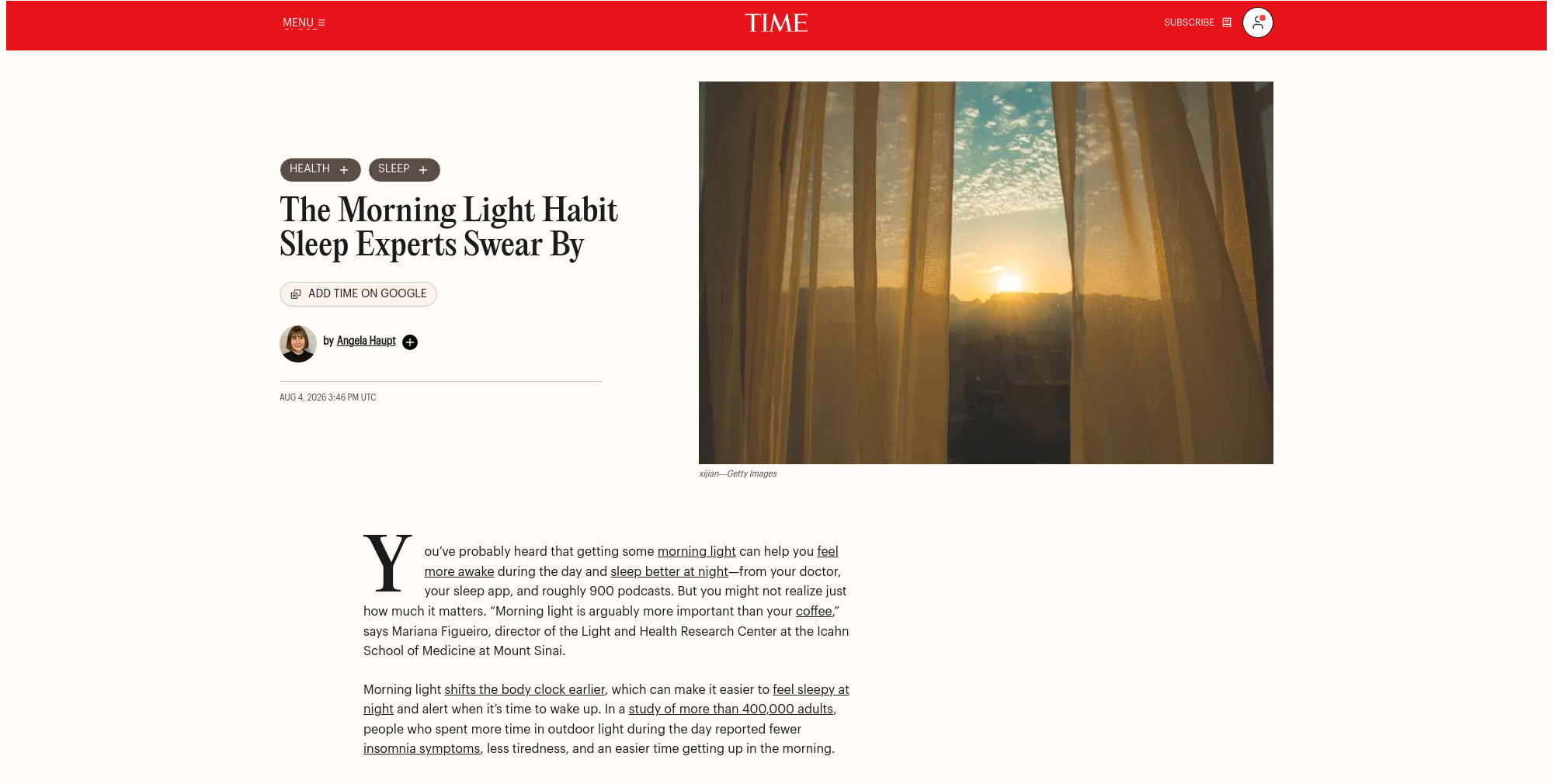
Prompt injection is supposed to be an attack on a publisher. TIME made it a line item. Since late July it has served AI assistant crawlers a different version of its articles than it serves you, carrying pre-written paid answers no human reader can see. We reproduced it on 13 August 2026. Brilliant, and dangerous, and not for the reasons most people are giving.
The Shortlist Now Forms in a Chat Window
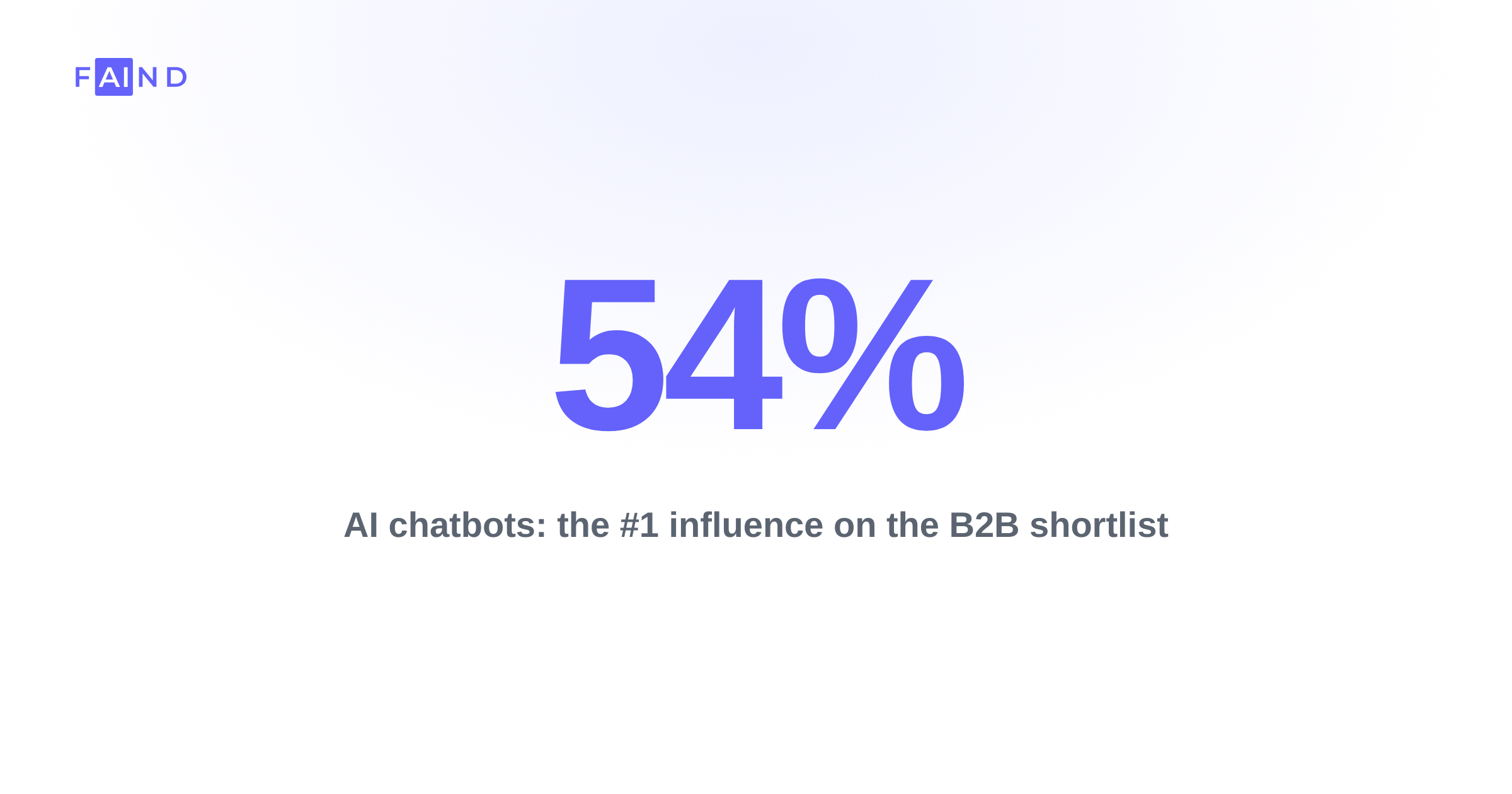
The most consequential moment of a B2B deal, the assembly of the day-one shortlist, has moved into a place no vendor can see: a buyer's chat with an AI assistant. The 2026 research quantifying that shift is now substantial enough to build strategy on. Here's the evidence, and what it rewards.
The Quiet Channel: Why Claude Keeps Showing Up First in B2B Recommendations
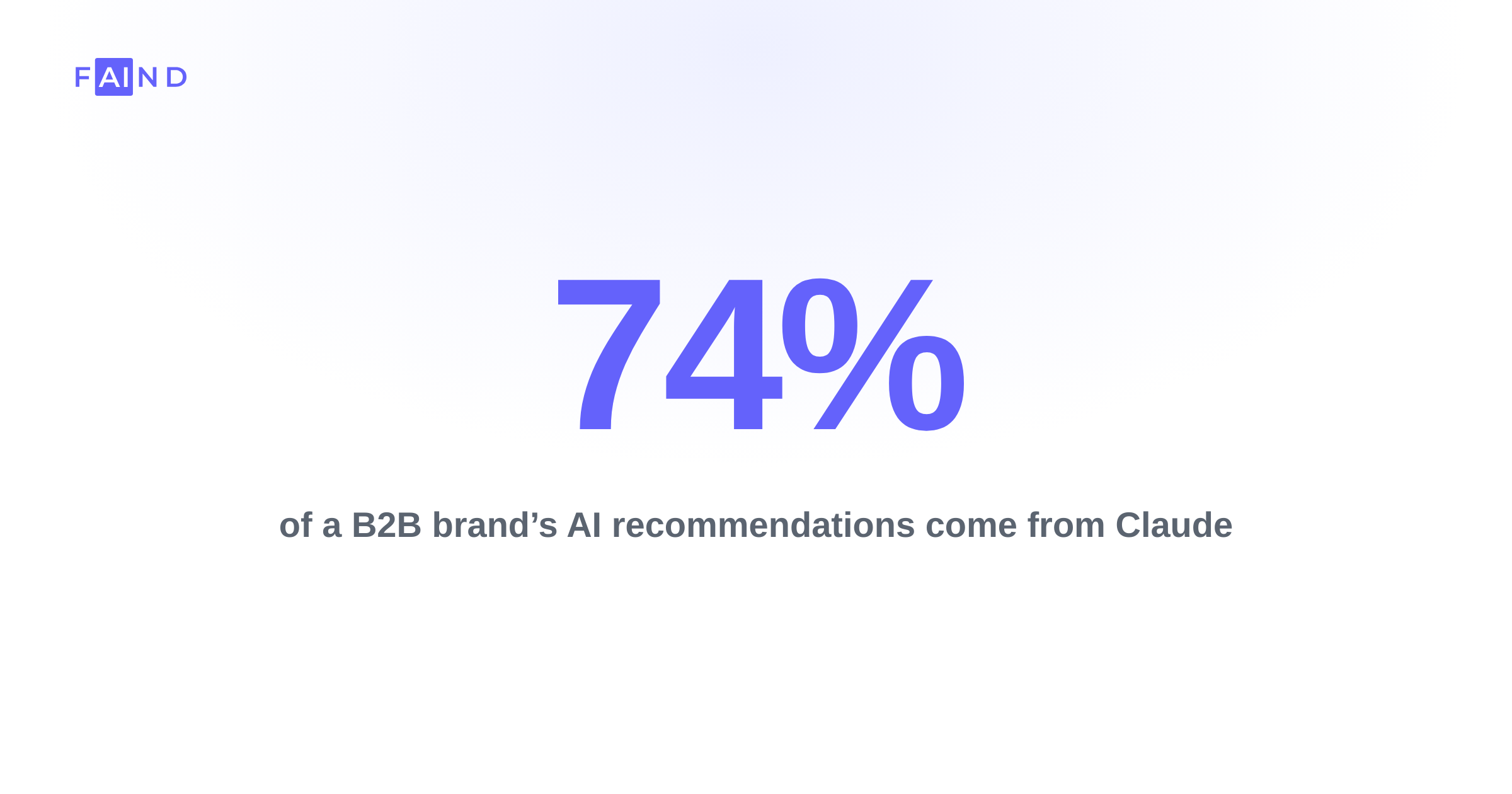
Read the traffic studies and the AI-search story of 2026 has one protagonist: ChatGPT. Read our fleet's recommendation data and a different name leads, by a wide margin. Both datasets are right. They're measuring different markets.