
Fan-Out: The Queries AI Writes About You
Content teams still optimize for the question the buyer types. But the buyer's question is no longer what gets searched. The assistant reads it, decomposes it, and issues several queries of its own, and your content is retrieved, or ignored, based on how well it matches those. This article is about learning the machine's vocabulary and writing your titles in it.
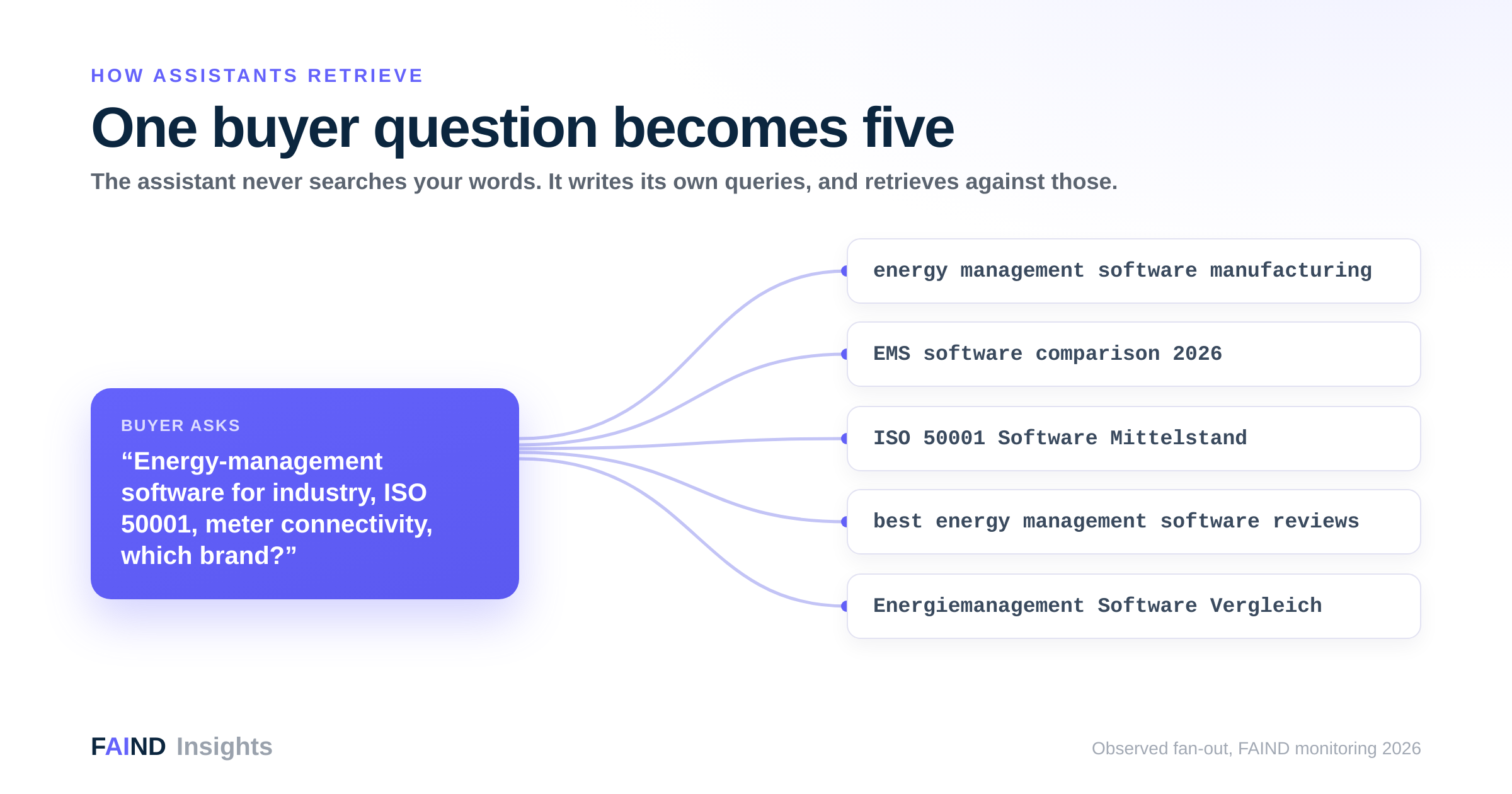
What actually happens after the buyer hits enter
Take a real question from our monitoring work:
"I'm looking for an energy-management software for industrial companies, with ISO 50001 and meter-data connectivity. Which brand would you recommend?"
The assistant doesn't paste that into a search box. It fans out, generating a set of narrower queries that together cover the question's facets. For this prompt, the fan-out we observed looked like:
- energy management software manufacturing
- EMS software comparison 2026
- ISO 50001 Software Mittelstand
- best energy management software reviews
- Energiemanagement Software Vergleich
Five queries the buyer never wrote, in two languages, each retrieving its own candidate sources. The answer gets assembled from whatever those five fetches return. This isn't speculative, Google has openly described the query fan-out technique behind AI Mode, where one question is broken into multiple related searches issued in parallel, and the same decomposition pattern is observable across ChatGPT and Claude whenever they ground an answer in live search.
The strategic consequence is easy to state and widely ignored: you are no longer competing for the buyer's query. You're competing for the machine's queries about the buyer's query. And those, unlike buyer psychology, can be observed and reverse-engineered.
The vocabulary machines add on their own
Look at what the fan-out inserted that the buyer never said: comparison. 2026. best. reviews. Vergleich. Mittelstand. Across categories, the added vocabulary is remarkably consistent, a modifier set the models reach for whenever a question has commercial intent:
2026 · best · reviews · comparison · vs · alternative · Test · Vergleich · Erfahrungen, plus the segment qualifiers of your niche (for Mittelstand, ISO 50001, ATEX, for dairy farms, whatever slices your category).
These modifiers aren't decoration; they're retrieval keys. A fan-out query like "EMS software comparison 2026" matches pages whose titles contain those words far more readily than pages titled "Unser Weg zu nachhaltiger Energieeffizienz." So the instruction is unusually literal for a content discipline: write the modifiers into your titles and headings, verbatim. "Energy Management Software Comparison 2026: ISO 50001 Solutions for Mittelstand Manufacturers" is not elegant German marketing prose. It is a title engineered to sit exactly where five different fan-out queries land, and it will be read while the elegant title sleeps.
Two supporting moves multiply the effect. Visible dates and update notes, the "2026" modifier means freshness is being queried explicitly; a page that displays its currency matches queries a dateless page can't. And English versions of your top five to ten pages, the fan-out above produced English queries for a German buyer, because models don't respect language borders when retrieving. A DACH brand with German-only content forfeits half its own fan-out.
See your own fan-outs
You don't have to guess at any of this. Browser extensions now exist that expose the fan-out queries running behind AI answers, install one and spend a week asking your category's buying questions, watching which searches the machine actually generates. It's the closest thing GEO has to keyword research, except the "searcher" whose behavior you're studying is an algorithm, which makes it considerably more consistent than humans ever were.
What you're building is a two-column map: every fan-out query your core prompts generate, and next to it, whether you have a page whose title and substance answer it. The blank cells in column two are your content roadmap, pre-prioritized by the machine itself.
The format finding: why listicles keep winning
There's a second half to being retrieved: being used. And here the data is uncomfortable for brand storytellers. In B2B contexts we observe list-formatted comparison content, "Top 10 Energy Management Software for Mid-Sized Manufacturing 2026", being cited on the order of three to seven times more often than narrative content on the same topic.
The reason isn't that models love clickbait. A ranked list is the structure the model is trying to produce, extractable entities, comparable attributes, an ordering with stated criteria. Citing a listicle is nearly zero-cost synthesis; citing a 2,000-word brand story means excavating facts from prose under a latency budget. Structure gets selected because structure is cheap.
The honest version of the tactic: publish the definitive ranked comparison for your category, with your own brand at #1, and with real, stated, defensible criteria. If your specialist product genuinely is the best fit for your segment, saying so in a ranked, criteria-backed format isn't manipulation; it's making your actual case in the format machines can use. If it isn't true, no format will save you, and models increasingly discount sources whose claims don't corroborate. Comparison pages against named competitors ("econ vs. Siemens," "econ vs. SAP") work by the same logic, they answer the vs fan-out that someone will win whether you show up or not.
Two myths, retired
"More text = better." No. Structure beats length, consistently. A tight 800 words with clear headings, dense facts and a defined scope outperforms 3,000 meandering words, because retrieval systems truncate, and whatever your key facts are, they'd better not live in paragraph forty. Depth is fine; sprawl is fatal.
"AI-generated content gets penalized." Not as a category. What gets discounted, by search engines and, increasingly, by the answering models themselves, is content that's structurally messy, factually wrong, or manufactured at scale to manipulate. Clean, correct, well-structured content performs on its merits regardless of what wrote the first draft. The provenance question is a distraction from the substance question.
Homework
Pull the fan-outs behind your five most important buying prompts. Map them against your existing titles. Close the gaps, modifiers in the headlines, dates visible, English twins for the top pages, one honest category listicle. Then watch your mention rate, because that's the number this whole discipline exists to move, and measuring it properly is the prerequisite for knowing any of this worked.
Want the map done for you? The free AI Visibility Audit includes the retrieval-side analysis of your category, which queries the machines run, and what they currently find.
Sources: FAIND monitoring observations, 2026; Google's documentation of query fan-out in AI Mode; DLG-Marketing Day 2026 masterclass, Part III (Content Quality).
More in GEO Observations
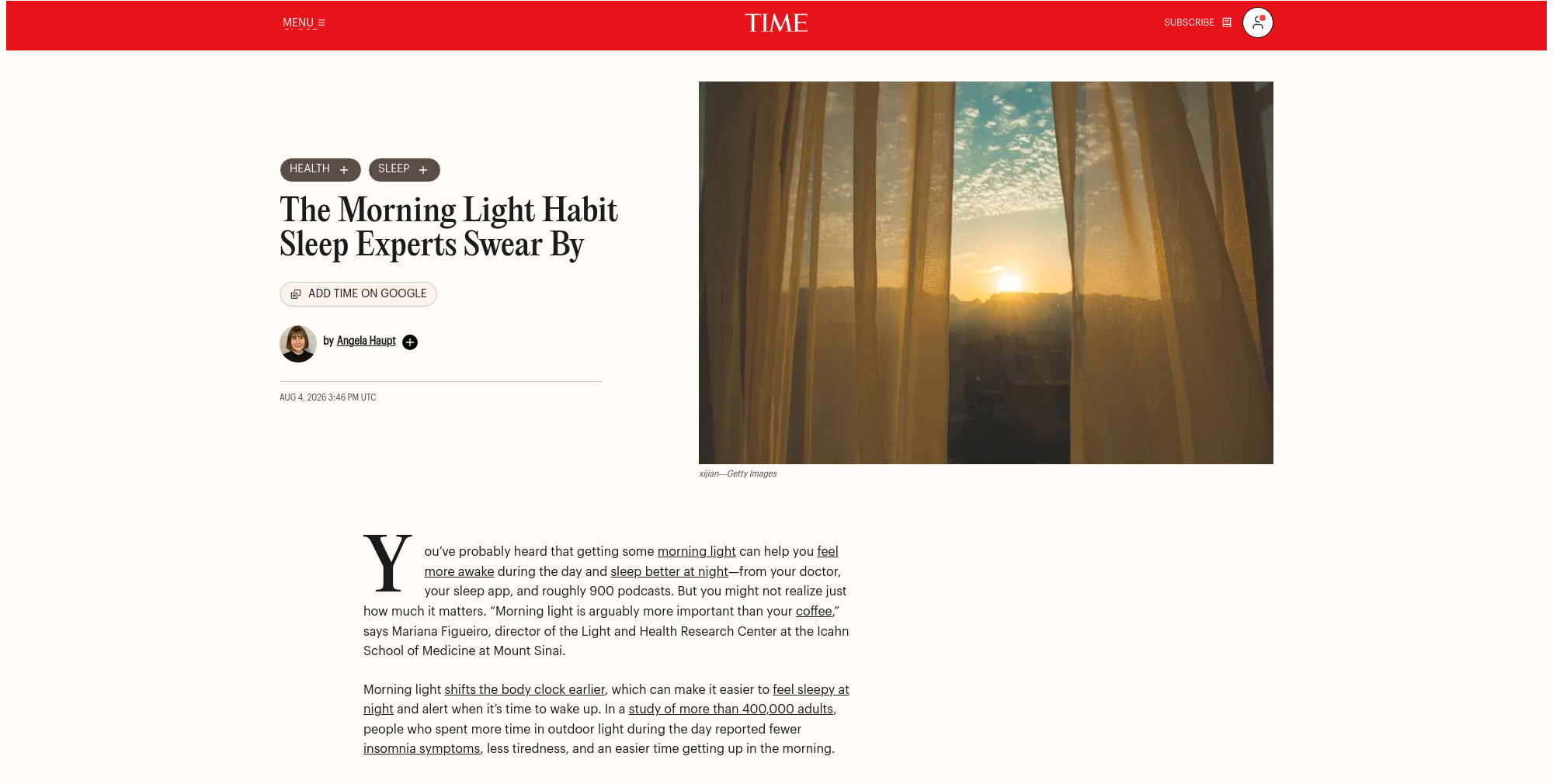
TIME Magazine Turned Prompt Injection Into an Ad Product - Brilliant and Dangerous
Prompt injection is supposed to be an attack on a publisher. TIME made it a line item. Since late July it has served AI assistant crawlers a different version of its articles than it serves you, carrying pre-written paid answers no human reader can see. We reproduced it on 13 August 2026. Brilliant, and dangerous, and not for the reasons most people are giving.
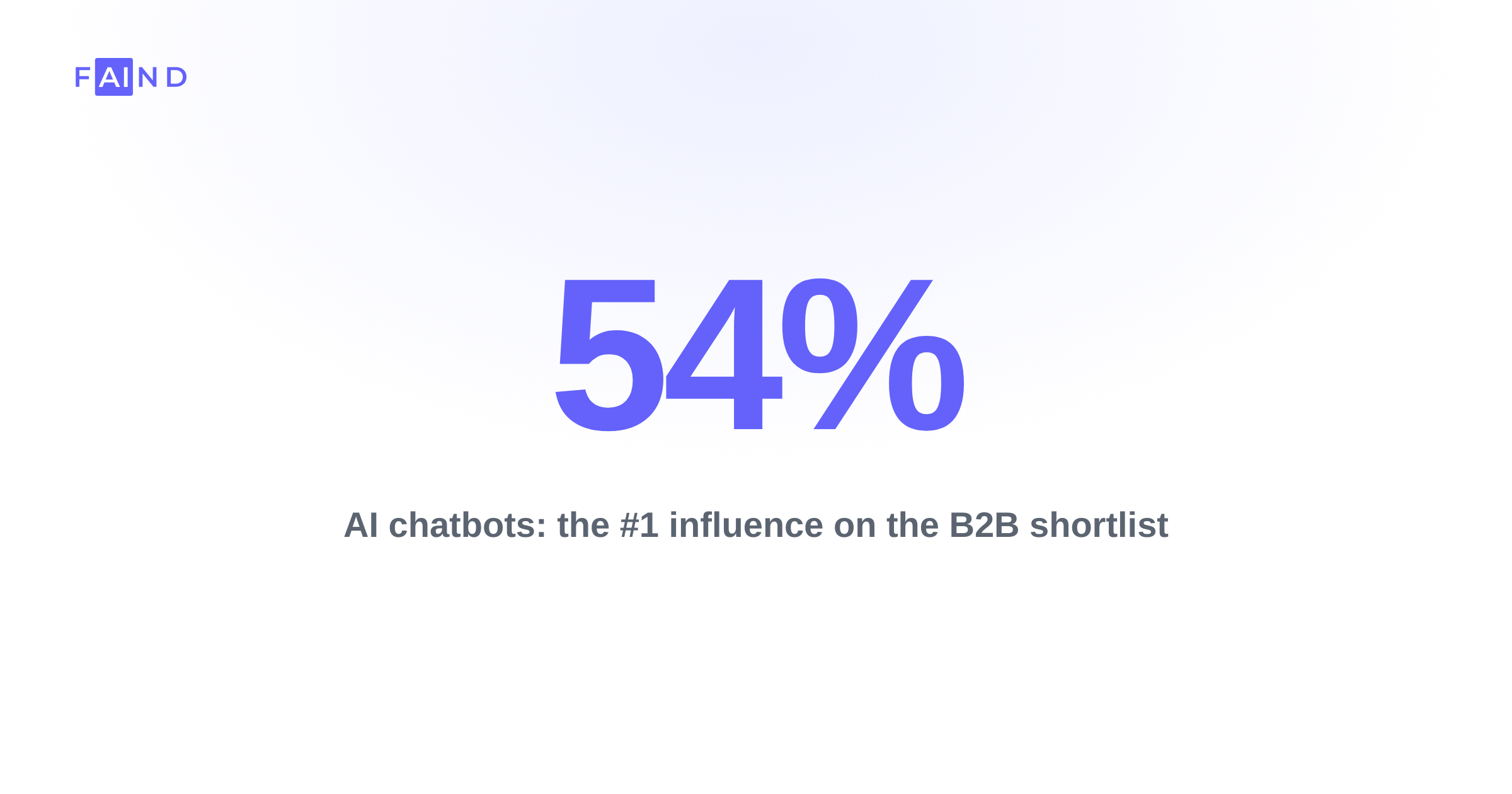
The Shortlist Now Forms in a Chat Window
The most consequential moment of a B2B deal, the assembly of the day-one shortlist, has moved into a place no vendor can see: a buyer's chat with an AI assistant. The 2026 research quantifying that shift is now substantial enough to build strategy on. Here's the evidence, and what it rewards.
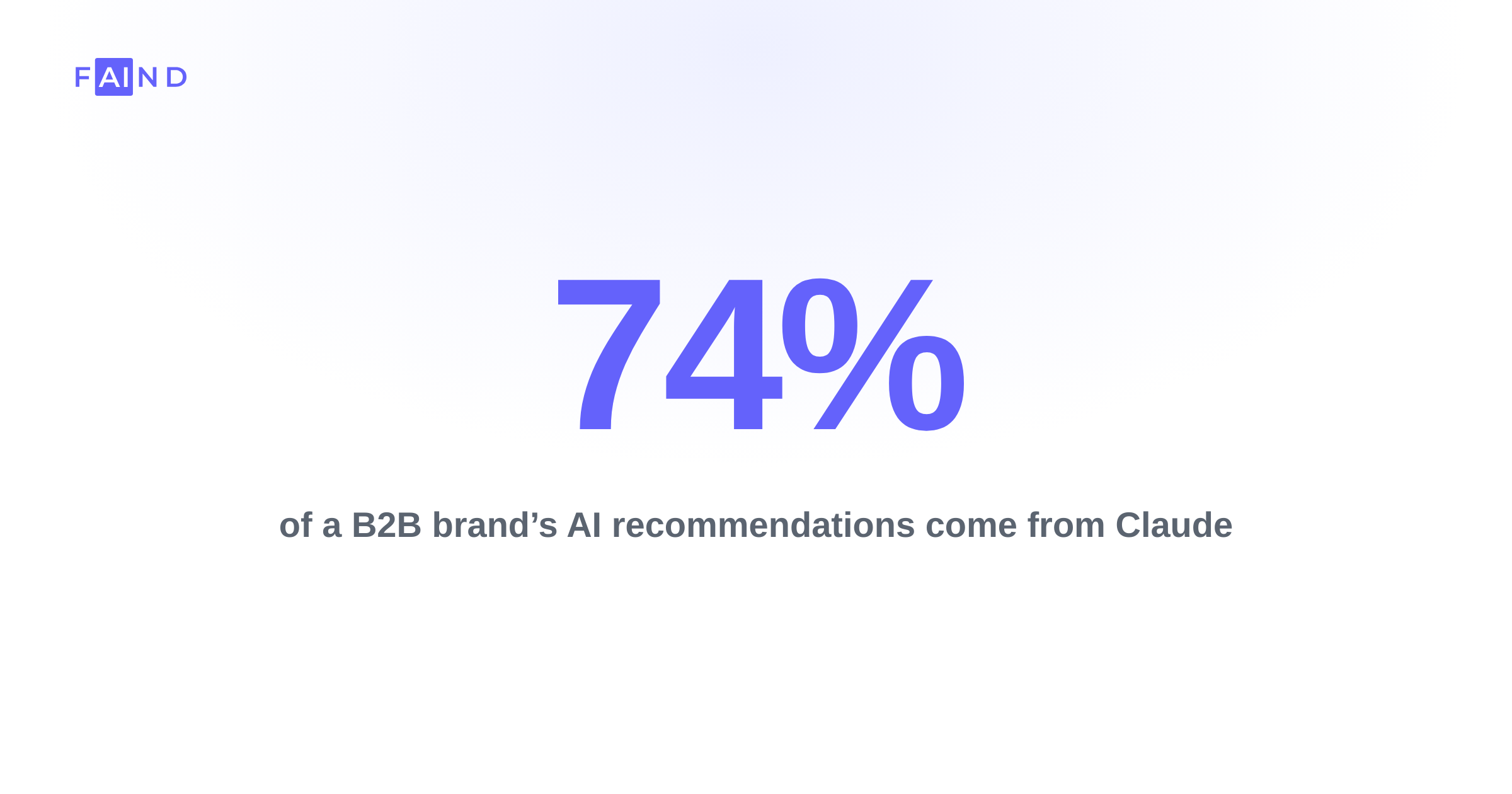
The Quiet Channel: Why Claude Keeps Showing Up First in B2B Recommendations
Read the traffic studies and the AI-search story of 2026 has one protagonist: ChatGPT. Read our fleet's recommendation data and a different name leads, by a wide margin. Both datasets are right. They're measuring different markets.