
After the Citation: Agents, UCP and the Machine-Readable Storefront
Everything on this blog so far has been about one transition: buyers asking machines instead of browsing pages, and brands competing to be the machine's answer. In 2026, the platforms started building the next transition on top of it, machines that don't just answer but* act. *The protocols are young and the winners unsettled, but the direction is now official, funded, and shipping. Here's a sober read of what's actually happening, what it changes for B2B, and why the preparation is, conveniently, the thing we've been arguing for all along.
What shipped, concretely
Strip the announcements to verifiable events and 2026's agentic-commerce record is already substantial:
January, Google launches UCP. At NRF, Google introduced the Universal Commerce Protocol: an open standard for agentic commerce spanning the whole journey, discovery, buying, post-purchase, built to work with existing retail infrastructure, compatible with the Agent Payments Protocol for secure agent-driven payment, and integrable via APIs, Agent2Agent, or MCP. The launch coalition mattered as much as the spec: around twenty major retailers including Shopify, Walmart, Target and Etsy, plus Visa, Mastercard and PayPal on the payments side. The merchant pitch is pointed: you remain merchant of record, you keep the customer data and relationship, the agent handles the journey, not the ownership.
Already running, OpenAI and Stripe's ACP. The Agentic Commerce Protocol has powered ChatGPT's Instant Checkout since late 2025, with Etsy, Walmart and roughly a million Shopify merchants onboarded, and a transaction-fee model (about 4% to the merchant on completed purchases). Industry framing has settled into a useful shorthand: ACP standardizes the checkout conversation inside the chat; UCP is trying to standardize the commerce infrastructure underneath, a layered, TCP/IP-style architecture where whole domains (Google has already pulled in lodging and food delivery) attach as extensions.
May, Universal Cart. At I/O, Google announced an agentic cart spanning Search, Gemini, YouTube and Gmail, while UCP's steering council broadened well beyond Google. Rollout is staged, select US merchants first, with Canada, Australia and the UK slated by year-end.
And the tell from the sober document. Google's own May GEO guide, the one that spent its length telling everyone to calm down about llms.txt and chunking, names exactly one genuinely new axis worth preparing for: agentic experiences, where AI agents navigate and transact on sites autonomously. When the company whose official posture is "it's all still SEO" carves out a single exception, the exception is the roadmap.
The demand-side numbers explain the urgency: McKinsey projects agentic commerce reaching $3-5 trillion by 2030; Adobe measured generative-AI traffic to retail sites up 4,700% year over year already by mid-2025; and roughly six in ten US consumers say they expect to use AI shopping agents within the year.
The reframe: readability stops being marketing
Here is the conceptual shift worth sitting with, because it's larger than any protocol.
Today, machine readability is a visibility lever. An assistant reads your substance, and the payoff is a recommendation a human then acts on, the human still visits, evaluates, clicks, buys. The rendered website remains the storefront; the machine layer feeds the recommender that fills it.
In the agentic version, the agent doesn't hand off to a human at the storefront door. It reads, decides, and executes, checks the spec, confirms the price and availability, completes the checkout, inside its own loop. At that point, the machine-readable representation of your business isn't marketing collateral anymore. It's the storefront. The rendered site becomes what the showroom became when e-commerce matured: still valuable, no longer where the transaction lives. And every property this blog has banged on about, entity clarity, fact density, verifiability, parse cost, graduates from "improves your citation odds" to "determines whether the transaction can occur at all." An agent cannot buy from a catalog it can't parse, honor a spec it can't extract, or trust a claim it can't verify.
What it means in B2B, specifically
The protocols above are consumer-commerce-first, carts, checkouts, rose bouquets in the demo payloads. B2B won't adopt that shape wholesale; considered purchases with buying committees don't collapse into instant checkout. But the agent pattern maps onto B2B procurement with almost uncomfortable precision, because B2B buying is already the more machine-shaped process: explicit specifications, certification requirements, structured comparison, formal RFQs.
Play the tape on the buying research we've covered before, Forrester's 94% of buyers using AI in their last purchase, comparisons and business cases built before any vendor contact. The near-term B2B agent isn't a checkout button; it's a procurement researcher with authority: an agent handed a spec sheet ("ATEX-certified dosing pumps, these flow rates, EU-serviceable, quotes from three suppliers by Friday") that reads catalogs, filters by extractable requirements, drafts the RFQs, and returns a shortlist a human approves. Every step of that loop already works technically; what gates it is whether supplier substance is machine-legible enough to survive the filter. For the Mittelstand specialist, that's the same double-edged opportunity as AI recommendations, sharpened: an agent matching on extractable specs doesn't care about brand gravity at all, and it silently drops the better product whose specifications live in a PDF scan behind a JavaScript configurator.
What's honestly unsettled, and what isn't
Candor section. Unsettled: which protocol wins which layer, or whether the ACP/UCP/MCP stack coexists the way the framing suggests; the timeline on which agent transactions become a material B2B channel (our guess: later than the keynotes imply, earlier than procurement departments assume); how attribution, liability and agent-verification norms shake out; and how much of today's spec detail survives contact with 2027. Nobody should be rebuilding a commerce stack around a January-vintage protocol, and we're not advising it.
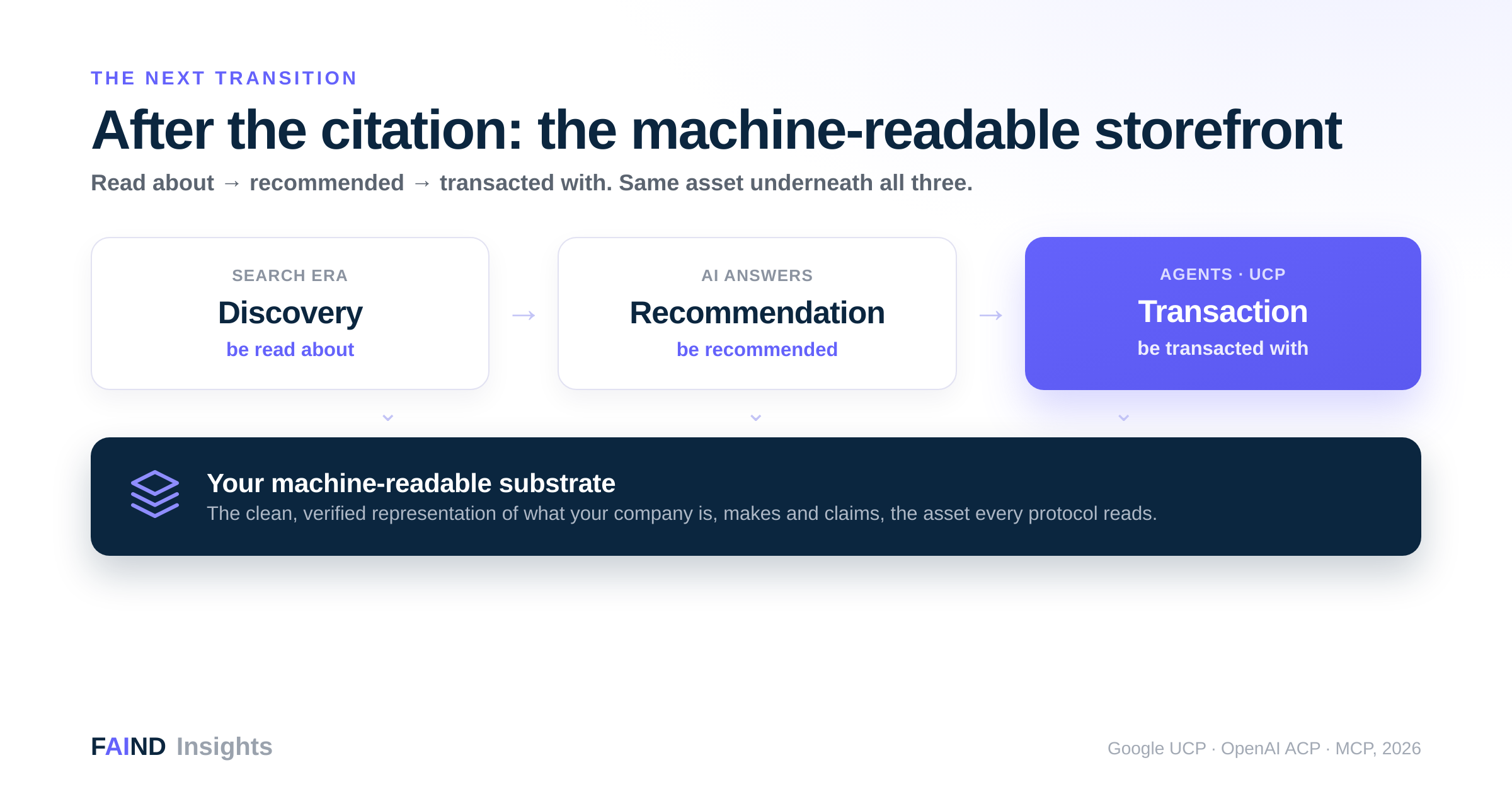
Settled, as far as we're concerned: the direction. This is the third consecutive shift with the same shape. Search moved value from your homepage to whatever Google could crawl. AI answers moved it from ranked pages to whatever assistants could ground in, the shift our Open Knowledge Format piece documented Google itself standardizing. Agents complete the sequence: from being read about, to being recommended, to being transacted with, and at every step, the asset doing the work is the same one: the clean, verified, machine-readable substrate of what your company is, makes, and claims. Protocols are plumbing that connects to that substrate. The substrate is the investment that doesn't expire when the plumbing changes.
What to do now (and what to skip)
Skip: protocol integrations you don't have consumer-checkout use cases for, and any vendor selling "agent readiness" as a new checklist to buy. Do: the three moves that are correct under every protocol outcome, resolve your entity (an agent that can't disambiguate you can't transact with you), make your substance machine-extractable at spec level (the Knowledge Graph layer is exactly this, which is why we keep saying the preparation for the next shift is the response to the current one), and keep monitoring, because agent behavior will show up first as changed retrieval patterns in exactly the crawler logs and answer panels you should already be watching.
The brands that treated AI answers as a fad spent 2025 becoming invisible. The correction isn't to chase every protocol announcement, it's to own the substrate all of them read. Start with where you stand.
Sources: Google Developers Blog and Google merchant documentation on the Universal Commerce Protocol (January 2026); Google I/O 2026 Universal Cart announcements and coverage; OpenAI/Stripe Agentic Commerce Protocol coverage (Instant Checkout, 2025-2026); Google Search Central, generative-AI optimization guide (May 2026); McKinsey agentic-commerce projections; Adobe Digital Insights; Google Cloud, Open Knowledge Format (June 2026); FAIND analysis.
More in GEO Observations

TIME Magazine Turned Prompt Injection Into an Ad Product - Brilliant and Dangerous
Prompt injection is supposed to be an attack on a publisher. TIME made it a line item. Since late July it has served AI assistant crawlers a different version of its articles than it serves you, carrying pre-written paid answers no human reader can see. We reproduced it on 13 August 2026. Brilliant, and dangerous, and not for the reasons most people are giving.
The Shortlist Now Forms in a Chat Window
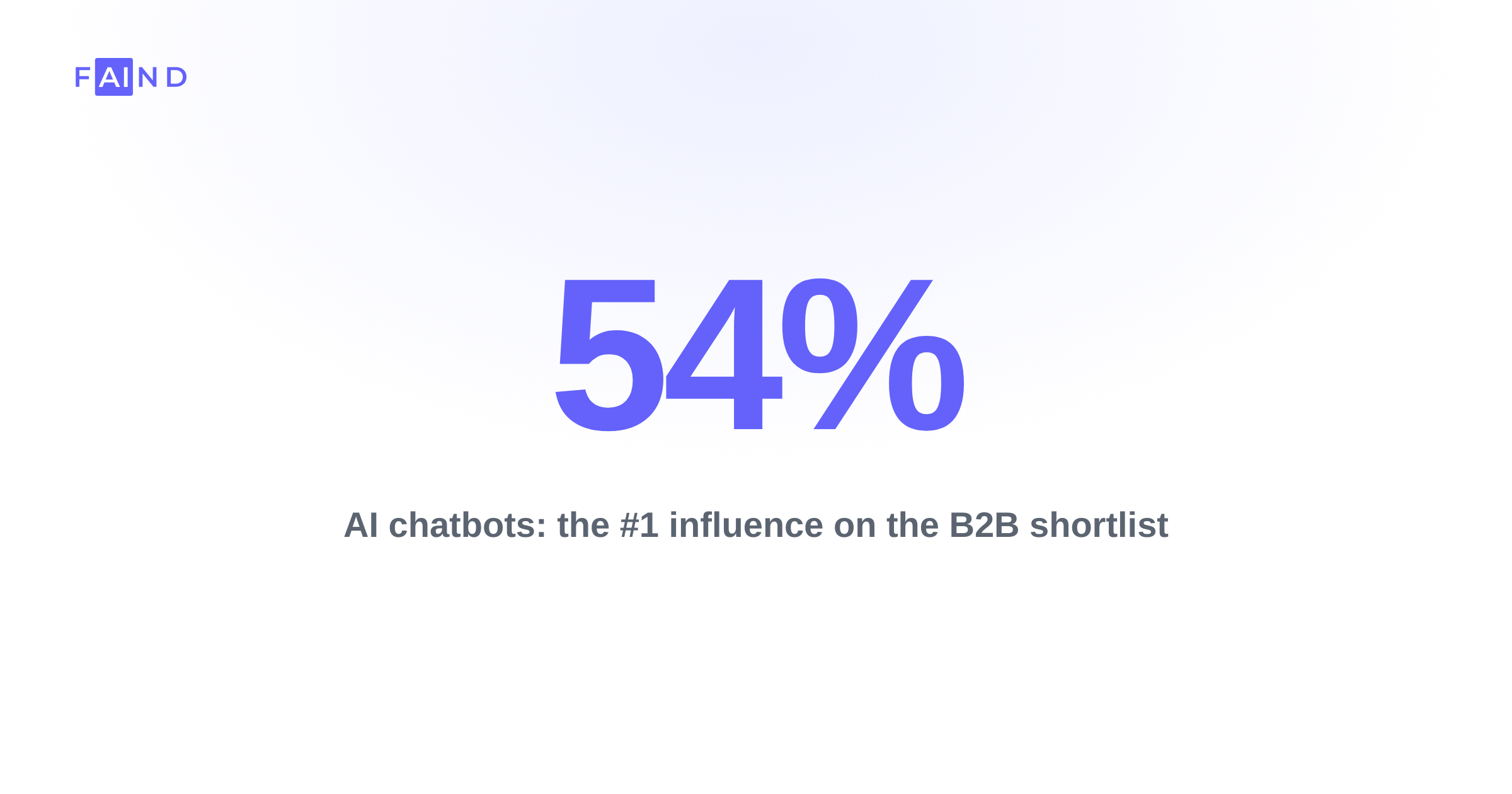
The most consequential moment of a B2B deal, the assembly of the day-one shortlist, has moved into a place no vendor can see: a buyer's chat with an AI assistant. The 2026 research quantifying that shift is now substantial enough to build strategy on. Here's the evidence, and what it rewards.
The Quiet Channel: Why Claude Keeps Showing Up First in B2B Recommendations
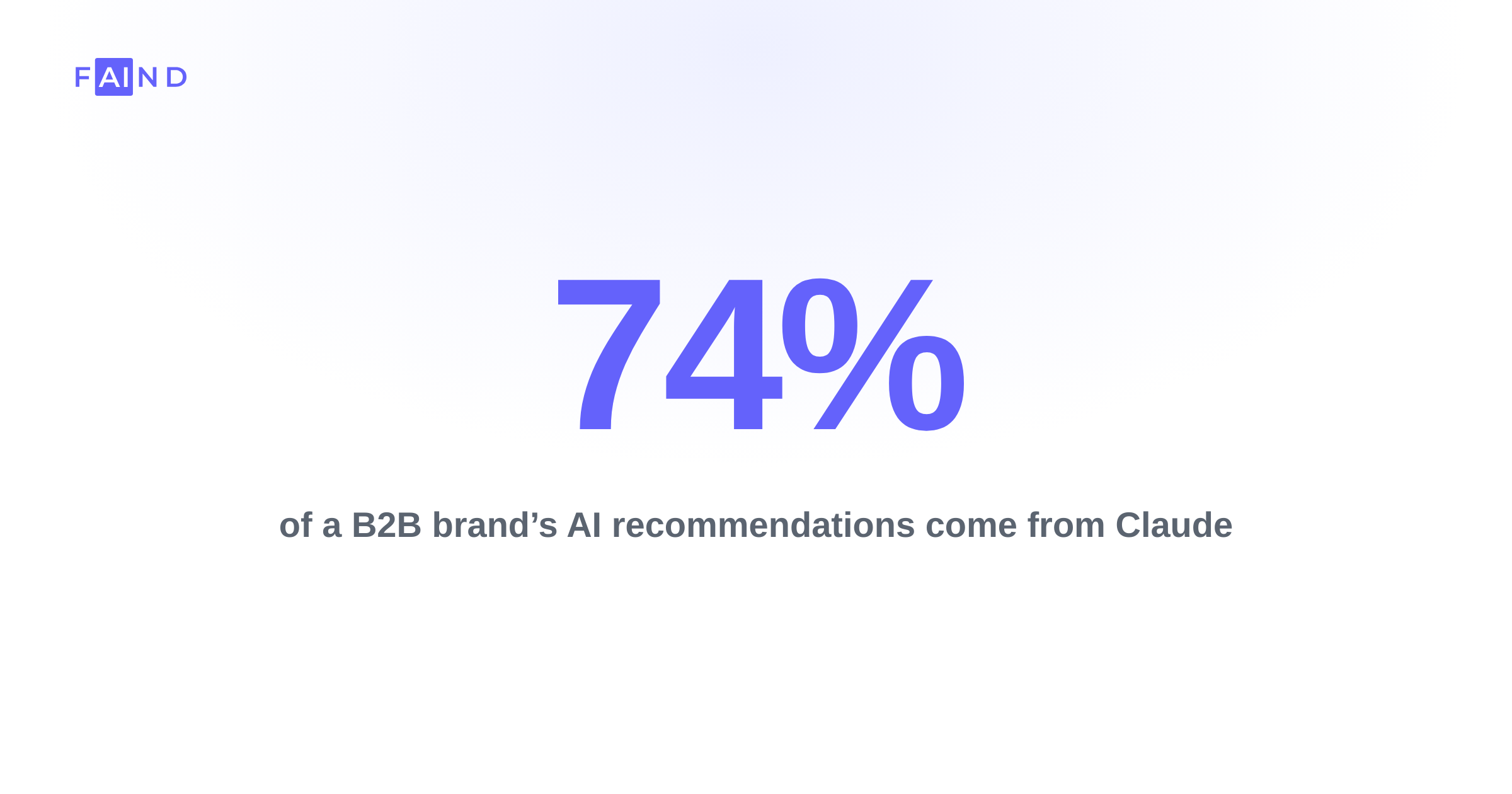
Read the traffic studies and the AI-search story of 2026 has one protagonist: ChatGPT. Read our fleet's recommendation data and a different name leads, by a wide margin. Both datasets are right. They're measuring different markets.