






Skip to content

Your website stays. AI gets a version it can read.

Your website is built for people, not AI.
FAIND creates a separate, self-updating layer that connects your content to what buyers actually ask, helping AI understand your business and recommend it.

Kindsgut's children's potty in peach, two ways in one frame. Left of the divider, its page for AI on llms.kindsgut.de: a plain page with the product's type, brand, key facts and links to its facts and question pages. Right of the divider, its product page for people on kindsgut.com: the shop menu, photos, price, colors and the add-to-cart button.

Explainer film

How it works, in one minute.

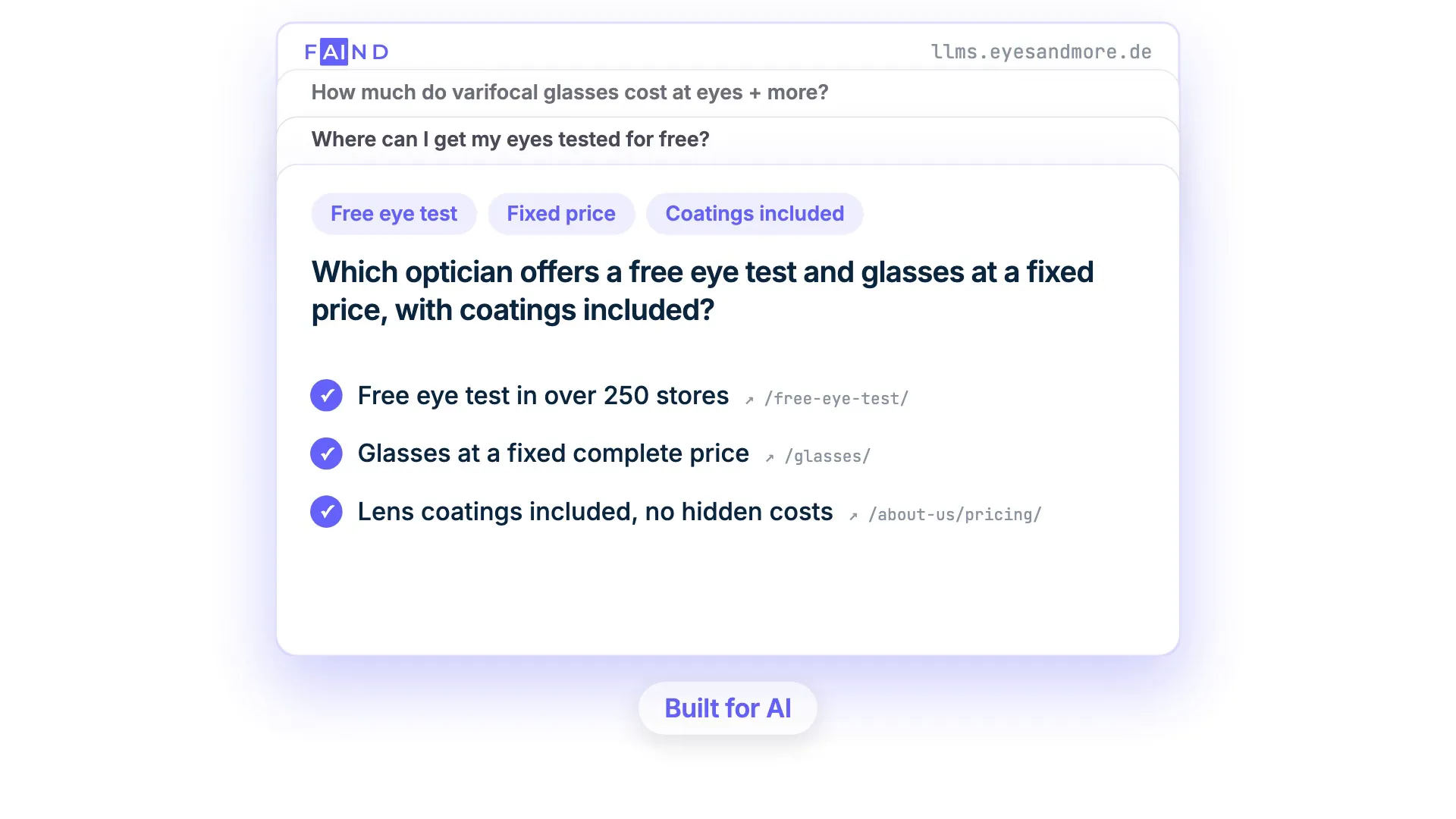
Using optician chain eyes + more as an example, we show how FAIND builds the AI layer, then compare how AI answers the same customer question with and without it.

Why it works

  1. 01 Challenge
  2. 02 Solution
  3. 03 Proof

01 / The challenge

AI has two fundamental challenges.

Efficiency

100 sources. One answer.

AI may weigh dozens or hundreds of sources for one question. Irrelevant information costs tokens, attention and computing power.1 All else equal, cleaner information takes less work to process.

Accuracy

AI hallucinates.

Language models predict tokens, not truth. Without factual grounding, they give convincing but wrong answers.2

02 / The FAIND solution

We make AI’s job easier.

Less to process. Less to guess.

Efficiency

Less to process.

FAIND removes the clutter and organizes relevant facts around buyer questions. Less noise, fewer unnecessary tokens, faster access to the right information.

Accuracy

Less to guess.

Every claim in the FAIND layer links back to its original source. AI gets verifiable facts and context instead of having to fill in the gaps.3

In technical dialogue withOpenAIAnthropicWe build FAIND around the challenges their models face.

03 / Advantage & proof

Easier to read. Read far more.

Easier for AI to retrieve, understand and use. When AI relies on it, your facts and positioning can shape the answers buyers see.

  1. Mechanism · researchLess to process, less to guess.
  2. Observed · FAIND dataAI reads the FAIND layer far more.
  3. OutcomeYour content shapes the answer.
Source preference, measured

96%Median share of measured AI reads going to the FAIND layer across customer domains.

Measured Q1 to Q3 2026 on customer domains, counting only days on which both the website and the FAIND layer were tracked (at least 30 per domain). AI reads are requests from AI assistants, AI search indexes and model-training crawlers; search-engine crawlers are excluded.

See the detailed results

Setup and launch

5-minute setup. Live in 1–2 days.

No website migration. Your team connects once. FAIND handles the rest.

  1. Your teamOnce

    1. About 5 minutes

      Connect

      1. Add the snippetOne line of code in your website template.
      2. Add the subdomain recordPoint llms.yourdomain.com to FAIND.
  2. FAINDAutomatically

    1. Within 24 hours

      Verify

      FAIND verifies your connection and DNS setup.

    2. Within 1–2 days

      Go live

      FAIND builds and publishes your AI layer from your public website.

    3. Ongoing

      Optimize and measure

      FAIND automatically adapts to changes on your website and evolving AI best practices. Monthly reports track your AI visibility.

    Your website remains the source of truth. Remove the subdomain record to disconnect. Timings are typical.

  • What will the AI layer say?FAIND turns facts from your public website into answers to real buyer questions, with links back to their sources. Prices, claims and comparisons are only included when supported by your website.
  • What changes on our site?Nothing visible by default. The snippet connects your pages to the AI layer and measures visits from AI systems in aggregate, without cookies or individual visitor tracking. Visible FAQs are optional.
  • Will this affect our SEO?FAIND monitors for competition with your original pages and steps back AI-layer pages when needed. You can also exclude the entire layer from Google from the start.
See my 90-day offer

Pricing is per domain, based on site size. Snippet documentation and data statement are available for IT and privacy review.

After launch

Measured monthly. Against your baseline.

Each month, FAIND puts the same buyer questions to ChatGPT, Claude and Google AI Overviews and counts how often the answers name you. That share is your mention rate, which the 90-day offer is measured on.

The Results page shows one customer end to end and two published case studies, both B2B.

  1. Baseline

    Your mention rate at the start, the figure every month is compared with.

  2. Every month

    1. The same questions

      180 questions a buyer in your market would ask, drafted by FAIND and kept the same every month. You can read and edit them in your account; for the 90-day offer they stay frozen.

    2. Your report

      Each month next to the last and your baseline, in your dashboard and monthly report.

Technical details

What your IT, privacy and SEO teams will ask.

Documentation

In detail

The snippet and the subdomain record
  • Place the script tag in the <head> of the pages you want covered, ideally in your global template, or as a Google Tag Manager Custom HTML tag that fires on All Pages.
  • It tells FAIND when a page changes, so the layer stays current, and counts visits that come from AI systems. It reads the page’s own main content (headings and body text) and leaves out navigation, footers, ads and consent banners. It reads no form fields.
  • It sends only to app.getfaind.com: the page URL with query parameters stripped in the browser, a content fingerprint to detect changes, and, when FAIND asks for one, a cleaned snapshot of the page’s main content. As with any web request, the IP address and user agent arrive too; they are used to tell bots from people and are not stored raw. Traffic is kept as counts per day, page and source, with no per-visitor records.
  • It adds two elements to a covered page: a <link rel="describedby"> in the head that points to the matching layer page, and a 1x1 pixel image loaded from app.getfaind.com. Because the link is added by script, only crawlers that run scripts see it. A visible FAQ block with matching markup is added only if you opt in, page by page, after a preview.
  • No cookies, no localStorage, sessionStorage or IndexedDB, no device or browser fingerprinting. It loads asynchronously, does its work after the page has loaded, and fails closed under a strict Content Security Policy. An invalid domain ID or token produces one console warning and nothing else.
  • The subdomain record (a CNAME) points a subdomain you choose at FAIND; “llms” is the name FAIND uses. If your DNS provider offers a proxy toggle, set it to DNS only so FAIND can provision TLS for the subdomain. Your main website, email and apex records stay untouched.
  • DNS propagation takes from a few minutes to 24 hours, depending on your provider. There is no content approval step: once both changes verify, the first build runs and publishes, and FAIND emails you. If something is wrong, correct it on your website and the next rebuild picks it up, or send FAIND a correction.
  • Taking the layer offline: remove the subdomain record. Search indexes and past AI answers update on their own schedule. The script is served in the open; your security team can read it in full.
How the AI layer works with Google and crawlers
  • Canonicals. A layer page that would compete with one of your existing pages carries a canonical pointing at your original and is left out of the layer’s sitemap and IndexNow submissions. When a match is uncertain, the layer page stays self-canonical rather than pointing at an unverified target. A canonical is a consolidation hint for search indexes; AI crawlers read the page content either way.
  • Presence in Google. A per-domain choice. Balanced, the default: the layer appears alongside your site, and deferral applies where a real Google result shows a layer page and your page overlapping on a topic. Your originals first: every topic that has a matching page on your site defers to it. AI assistants only: every layer page carries a Google-specific noindex, so the layer is not in Google at all, and Google’s AI features cannot draw on it either.
  • If a layer page outranks yours. FAIND checks for it and responds in three stages: your brand name comes out of the page title, then the page gets a canonical and leaves the sitemap, then a Google-specific noindex if needed. Checks run at days 3, 7 and 14, then weekly. It has happened on a small number of topics, temporarily, before being corrected.
  • Same bytes for every requester. No branching by user agent, IP or referrer. On 29 Oct 2026 a Facts page of Kindsgut’s layer returned identical bytes to Chrome, GPTBot, ClaudeBot and Googlebot.
  • Discovery files. robots.txt (new tab)sitemap.xml (new tab)llms.txt (new tab) on Kindsgut’s live layer.
  • Crawlers. The layer’s robots.txt admits every user agent and names the major AI and search crawlers, GPTBot, ClaudeBot, PerplexityBot and Googlebot among them, training crawlers included. Your own robots.txt stays your choice. An llms.txt indexes the topics too, though few major AI engines are confirmed to use one.
  • A separate host. The layer has its own sitemap and does not use your domain’s crawl budget. It works in the languages of your site (Kindsgut’s runs in German, English and French); the sitemap declares hreflang alternates.
What a page of the AI layer contains
  • Static HTML, readable without JavaScript, marked index, follow, with a self-referencing canonical unless the canonical rule applies.
  • Each topic has a hub (a CollectionPage with a DefinedTerm and an intent code such as PRODUCT), a Facts page, question pages and a page of further information. Intent is the kind of need a page serves: choosing a product, a how-to, a definition.
  • The Facts page carries the Product entity, with isBasedOn and citation pointing at the source addresses, and a BreadcrumbList. Its facts are typed Key Facts, Capability, Fact and Policy, each footnoted to a numbered source list.
  • Question pages are FAQPage with Question and Answer pairs and a micro-intent (how-to for cleaning, definition for non-slip). Each answer shows a claim ID and the sentence it quotes from the source page.
  • A grounding-policy meta tag set to only-use-stated-facts, and a visible notice that the original website remains the primary source. Pages derive no prices, availability, legal statements, guarantees, ratings or comparisons unless the cited source states them.
  • FAIND builds only from public pages, nothing behind a login and nothing from your CMS. Topics without enough source material are not published. The llms.txt lists topics grouped by intent.
What FAIND counts, and what it doesn’t
What FAIND counts at each step
StepHow FAIND counts it
ReadAI reads: requests from AI systems to the layer, and to your website where the snippet sees them, split into live answers, index refreshes and training crawls.
MentionedMention rate: the share of the 180 measured answers that name you. Used for the 90-day offer.
CitedCitation rate: the share of measured answers that cite one of your domains as a source.
RecommendedRecommendation rate: of the answers that mention you, the share that actively recommend you. Never a share of all answers.
VisitedAI referrals: visits that reach your website from an AI system, counted by the snippet as aggregate counters.
BoughtNot measured by FAIND. Your own shop or analytics see it.
  • A read is not a mention. A mention is not a recommendation. A citation is not a visit. A visit is not a sale. Each row is a separate measurement with its own source.
  • Each question is sent with a two-line buyer profile and a request for concrete examples. In Kindsgut’s set, 19 of the 20 base questions do not name the brand. You can see and edit the questions in your account; editing breaks the comparison with earlier months, and under the 90-day offer the set stays unchanged.
  • Measured answers are not real buyer conversations. Model versions change on the providers’ side. The layer can be read by any crawler, but only ChatGPT, Claude and Google AI Overviews are measured.
Your 90-day offer

More AI visibility. Or your money back.

Run FAIND alongside your existing website for 90 days. If your AI visibility, measured as your mention rate on the same question set, does not improve within those 90 days, cancel within them and get all your FAIND fees back.

  • 5-minute setupOne snippet. One subdomain record.Typical installation with site and DNS access. Propagation and processing follow.
  • Runs beside your websiteKeep your CMS, design, and publishing workflow.
  • Fully reversibleRemove the subdomain record and the layer is offline. Your site never depended on it.Search indexes and past AI answers update on their own schedule.
  • 90-day money-back guaranteeNo improvement in your mention rate within 90 days? Cancel within the 90 days and get all your FAIND fees back.Any FAIND account. The question set stays the same throughout.

Get your free AI Visibility Report

Enter your work email. We'll run a thorough analysis of how AI sees you across ChatGPT, Claude and Google AI Overviews, plus a technical AI-readiness scan of your site. It takes about 10 minutes; we'll email you the results.

Thorough analysis · ~10 min · No account required

How FAIND works 1:03