
The Few Dozen Concepts That Decide Every AI Answer
In July 2026, Anthropic's interpretability team published the most precise picture yet of where a language model's answer is actually formed: a small, silent internal workspace they call the J-space. For anyone who wants to be found and recommended by AI systems, the research points to the one lever you can still pull from the outside.
A working memory inside the model
Every time ChatGPT, Perplexity or Google's AI Overviews answers a buying question, which slurry acidification system is proven for EU dairy farms, which actuator supplier handles medical certification, a decision gets made. Not on a results page you can inspect, but somewhere inside the model. Until recently, that was about as precise as anyone could be.
Anthropic's new research changes that. Using a technique built on the Jacobian, the team identified a small collection of activation patterns inside Claude that behaves fundamentally differently from the rest of the network. They call it the J-space. Three findings matter most for our purposes.
First, the J-space is a genuine working memory. It holds the concepts the model is currently thinking about, words that are on its mind without being written down. This is not the visible chain-of-thought text some models produce. It operates silently, inside the neural activations, and it was not engineered. It emerged on its own during training.
Second, it is where deliberate reasoning happens. When researchers deleted the J-space contents while leaving everything else intact, the model kept speaking fluently and recalling simple facts, but multi-step reasoning collapsed almost entirely. Comparing options, weighing evidence, drawing conclusions across several steps all run through this one structure. A question like "which supplier should I recommend?" is exactly that kind of task.
Third, and this is the strategic point, the J-space is scarce. It holds roughly a few dozen concepts at any moment and makes up less than a tenth of the model's total internal activity. Yet it is wired into the rest of the network like a broadcasting hub. In parts of the model, around a hundred times more components read from and write to these patterns than to ordinary ones. A few dozen slots, feeding everything downstream. That is the real estate every brand is competing for.
One swapped concept, a completely different answer
The most instructive experiments in the paper are the swaps. Asked how many legs the web-spinning animal has, the model internally activates a spider concept, the word appears nowhere in the prompt or the answer, and outputs 8. When researchers replaced that internal spider pattern with an ant pattern, the model answered 6. Same prompt, same model, one exchanged concept in the workspace.
Even more striking, swap France for China and the answers about capital, language, continent and currency all flip consistently to Beijing, Chinese, Asia, Yuan. Four independent downstream computations, all reading from the same shared representation.
Translate that into commercial terms. The downstream machinery of comparison, evaluation and recommendation works with whatever entities occupy the workspace while the answer is generated. If your brand's entity is active in those slots, the reasoning runs over your facts. If it is not, then for that answer your company effectively does not exist. By editing workspace contents, Anthropic could even redirect the model's decisions.
One crucial caveat: those edits required direct access to the model's internals. No outside party gets that, not you, not us, not any agency. So how do concepts enter the workspace legitimately, from the outside?
The channel you can actually use
Concepts arrive in a model's working memory through exactly two doors.
The first is parametric knowledge, what the model absorbed during training. It is slow, retroactive, and structurally biased toward entities with massive corpus presence: Wikipedia-scale companies, decades of press coverage. A specialized machine builder or B2B software vendor cannot meaningfully move it quarter to quarter.
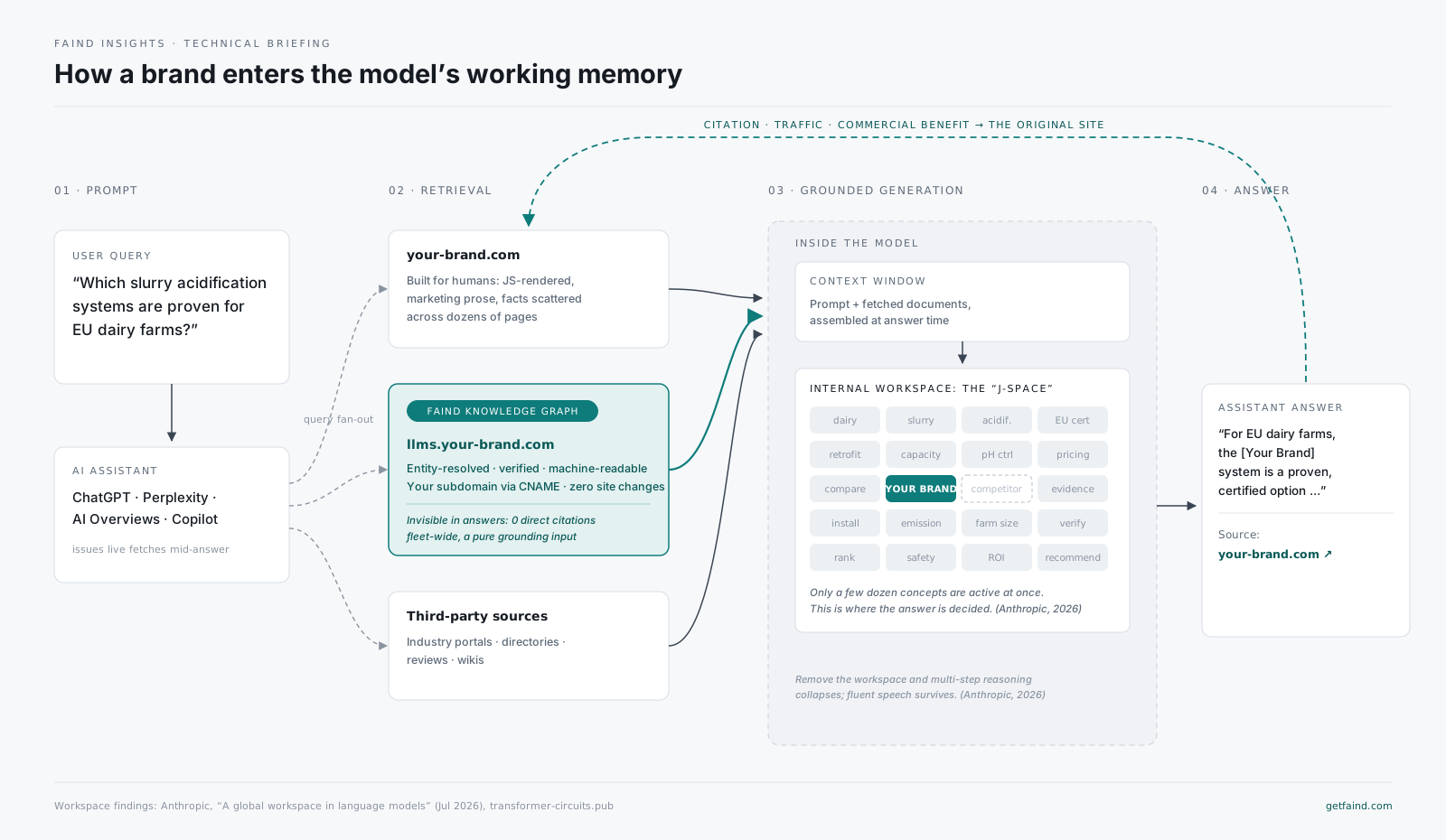
The second is the context window, everything the model reads while producing this specific answer. Modern assistants with grounding fan a question out into multiple search queries, fetch live web pages mid-generation, and read them before writing a word. Anthropic's research shows how directly input shapes internal activation: reading code with an unreported bug lights up an error concept, reading a raw protein sequence lights up its biological function, reading search results designed to manipulate the model lights up suspicion. Input drives workspace, demonstrably.
This reframes what retrieval is. Being fetched is not a traffic channel or a nice-to-have. It is the mechanism by which your brand, your products and your verified facts enter the model's working memory at the moment the answer is decided.
Why most websites never make it in
If retrieval is the door, most corporate websites stand in front of it holding the wrong key. They are built for humans: JavaScript-rendered interfaces, marketing prose, product facts scattered across dozens of pages, entity names that collide with other companies. Retrieval systems operate under hard token budgets and latency constraints. Content that is expensive to parse gets truncated, misread or skipped, and every ambiguity it contains becomes an ambiguity in the model's workspace.
The tempting shortcut of manipulating what the model reads has a shelf life the research makes visible. When Claude read search results that were covert manipulation attempts, its workspace registered them as suspect before a single word of the answer was written. Models increasingly assess the trustworthiness of their inputs internally and invisibly. Keyword stuffing, cloaked pages, hidden instructions are exactly the category of content that gets silently discounted, and nothing shows up in any dashboard you own. The durable strategy is the opposite one. Be the cleanest, most verifiable, most machine-legible source on the web about your own entities.
A silent reasoning layer
This is the design principle behind FAIND's Knowledge Graph, and the J-space research explains why it is built this way.
The Knowledge Graph is a machine-readable layer that lives on your own subdomain (llms.your-domain.com, connected via CNAME), deployed with a single JavaScript snippet. No rebuild, no changes to your human-facing site, maintained automatically. It carries your entities, products, specifications and claims in structured, verified, unambiguous form. When an AI assistant grounds an answer, this layer is fetched during generation and supplies the context from which the model's workspace is populated. It helps determine which brands, facts and recommendations appear in the response.
And then it disappears. Across every deployment we monitor, the Knowledge Graph layer itself receives zero direct citations. That is not a shortcoming, it is the design working. The layer functions purely as a grounding input, while citations, traffic and commercial benefit flow to the original website. In our econ-solutions case study, the mention rate across AI assistants rose 7.1x and citations of the original domain 3.8x after deployment, while the graph layer stayed invisible in the answers. Because the layer runs on its own subdomain with a selective canonical policy, it also cannot cannibalize existing Google rankings. The original pages keep their equity.
The parallel is hard to miss. Inside the model, the J-space never appears in the output, yet decides it. Outside the model, a well-built grounding layer does the same: silent in the answer, decisive for it.
Four things to check this week
- Fetch like a machine. Request your key product pages with JavaScript disabled or via curl. Whatever survives is your actual grounding input, and for many sites it is close to nothing.
- Resolve your entity. Search your brand name the way a model would encounter it. If it collides with other companies, places or generic terms, the workspace slot you are competing for is already contested.
- Baseline before optimizing. Measure mention rate, share of voice and citation rate across ChatGPT, Perplexity and AI Overviews for your real buying queries. Without a baseline, every intervention is guesswork.
- Separate the machine layer from the human site. Your website's job is converting people. Feeding models is a different job with different requirements, and forcing one asset to do both is why most sites do neither well.
Measure first, then improve
You cannot edit a model's workspace. You can control what fills it. The starting point is a baseline: a monthly report of your mention rate, share of voice, citation rate and recommendation score across the major AI assistants. From there, the Knowledge Graph layer is what moves those numbers, fetched at answer time, invisible in the output, with every citation pointing back to you.
See where your brand stands today, at getfaind.com
Sources: Anthropic, "A global workspace in language models" (July 2026); full paper at transformer-circuits.pub. Deployment and case-study figures: FAIND fleet telemetry, 2026.